
GHK-Cu is a synthetic copper-peptide complex for research. Its other names are Prezatide copper, GHK copper, and Copper tripeptide-1. Scientists classify it as a copper-binding tripeptide. The complex consists of the tripeptide Gly-His-Lys (GHK) bound to a copper (Cu²⁺) ion. Researchers study GHK-Cu for its role as a metal ion carrier in biochemical models. The focus is on its interaction with extracellular matrix components like collagen. Scientists often look for GHK-CU for sale to use it in in-vitro cell culture models to examine these interactions. They analyze how the copper ion influences peptide binding to cellular structures. This work aims to map copper-dependent signaling and matrix remodeling pathways. All research is conducted in controlled laboratory environments. The complex is a tool for studying metallopeptide chemistry and cell signaling. Kimera Chems provides this material for qualified scientific research only.
Chemical Composition & Purity
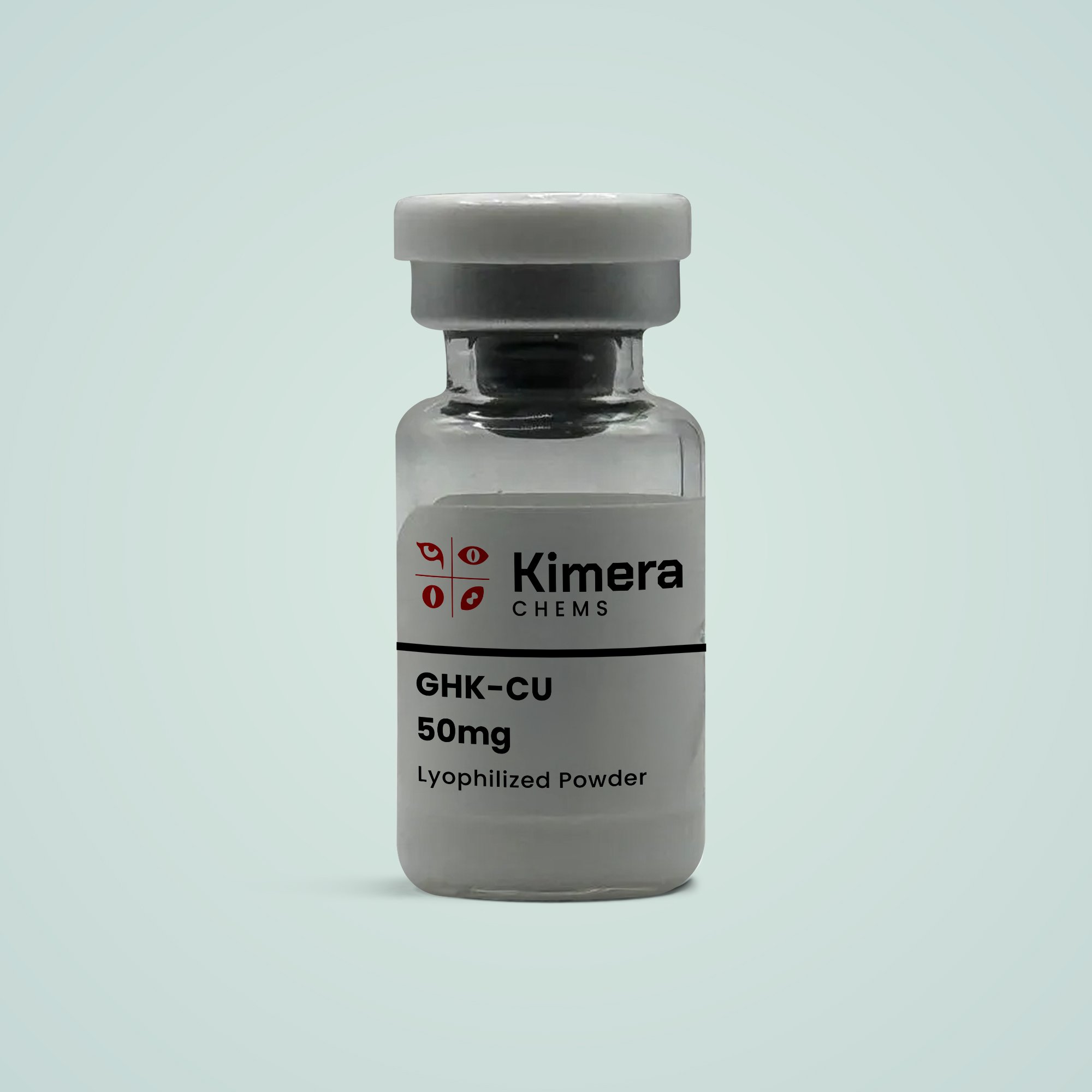
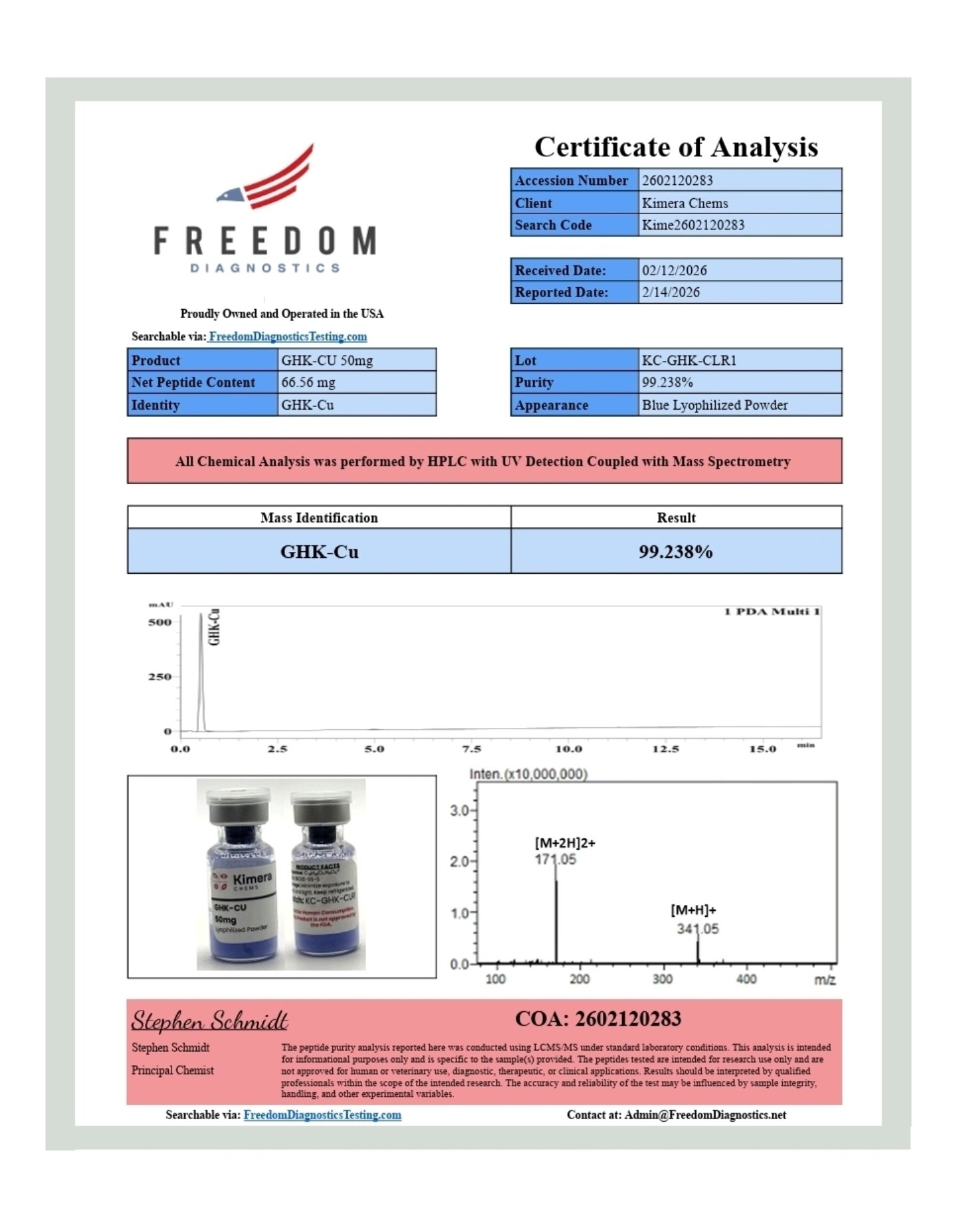
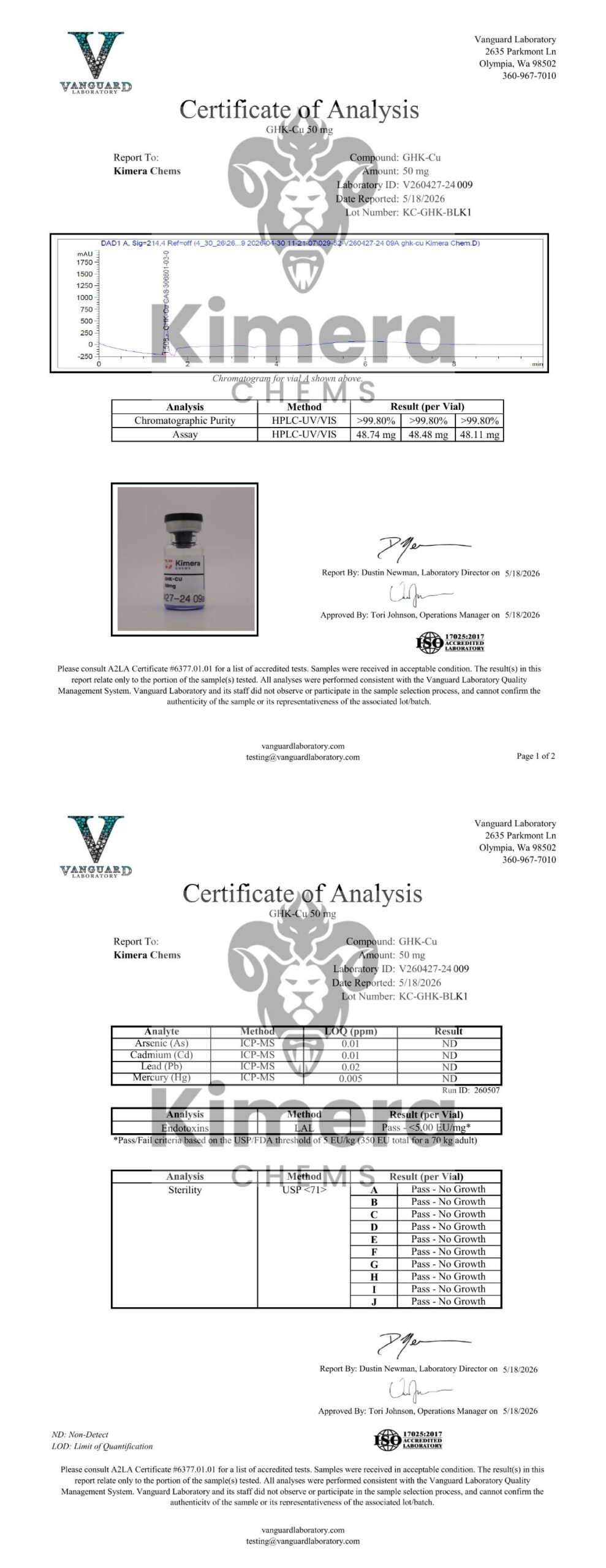
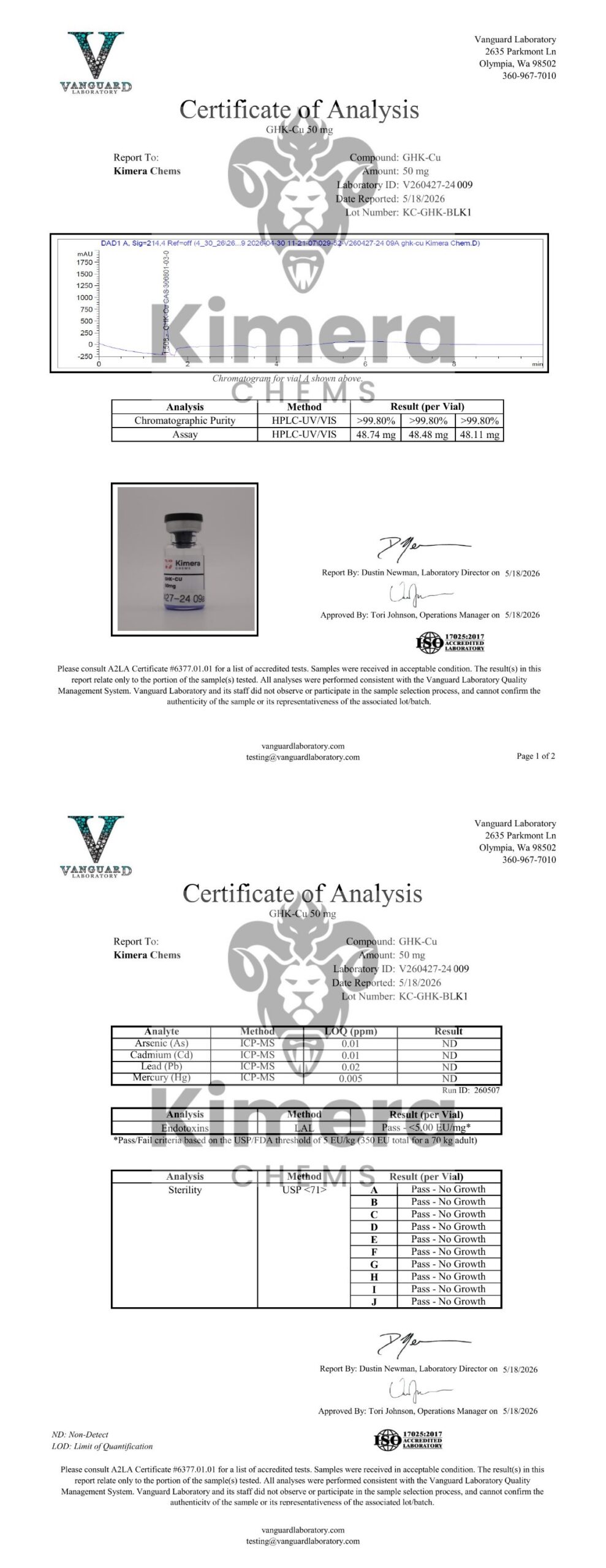
GHK CU research chem is supplied as a lyophilized powder. It appears as a distinctive blue to blue-green solid. This color is characteristic of copper(II) complexes. The molecular formula is C₁₄H₂₃CuN₆O₄⁺. The molecular weight of the compound is 402.92 g/mol. Kimera Chems verifies each batch for quality through high-performance liquid chromatography (HPLC). It is performed by a third party for analysis. This confirms the peptide’s identity and purity. The purity level is ≥98% for research use.
Research Applications
In the laboratory, GHK-Cu is used as a copper-delivery research agent. Its mechanism involves the stable coordination of copper by the GHK peptide. Researchers study it for its interaction with enzymes like lysyl oxidase. Scientists evaluate it in models of extracellular matrix synthesis and remodeling. All the research is performed in controlled in vitro settings.
- Copper Delivery Studies: For analyzing metal ion transport in culture.
- Extracellular Matrix Research: Use in collagen synthesis and fibroblast models.
- Enzyme Interaction Assays: Studying copper-dependent enzyme activity.
- Cell Migration Models: Application in wound healing assay protocols.
- Metallopeptide Analysis: Researching stability and binding characteristics.
Storage & Handling Protocol
Correct storage is essential for this copper complex. The blue color can fade if the compound degrades. You must follow standard laboratory safety procedures.
- Lyophilized peptides can be kept at room temperature, away from direct light.
- If reconstituted, the sample should be kept in the fridge.
- For long-term storage, the material must be stored in the freezer.
- Store with a desiccant in a very dry environment.
- Store in an opaque or amber vial; light can degrade the complex.
- Always keep the powder in a tightly closed vial.
- Use sterile, non-metallic equipment if reconstituting.
Compliance & Usage Disclaimer
This product is for Research Use Only (RUO). It is a chemical for laboratory analysis. It is not for human or animal use. It is not a drug, supplement, or cosmetic. Any GHK-CU copper peptide for sale is for authorized research only.
Availability & Research Sourcing
Kimera Chems is a reliable source for high-purity chemicals for the global scientific community. Laboratories can buy ghk-cu peptide from our platform. We ensure that every batch meets the high standards required for research.
| CAS Number | 89030-95-5 |
| Other Names | Prezatide copper GHK copper Copper tripeptide-1 CG-copper peptide Oristar Cu-GHK UNII-6BJQ43T1I9 Copper Tripeptide 1 6BJQ43T1I9 DTXSID20237492 |
| IUPAC Name | copper (2S)-6-amino-2-[[(2S)-2-[(2-aminoacetyl)amino]-3-(1H-imidazol-5-yl)propanoyl]amino]hexanoate |
| Molecular Formula | C14H23CuN6O4+ |
| Molecular Weight | 402.92 |