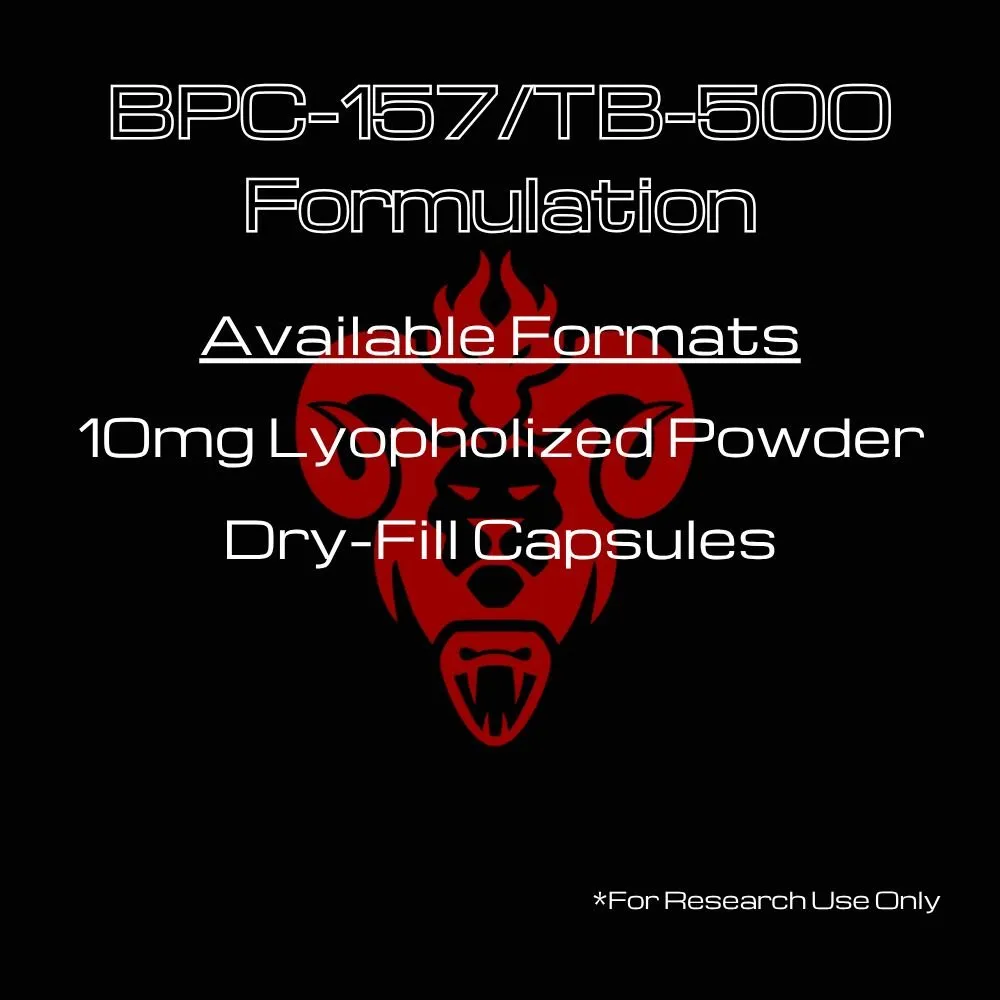
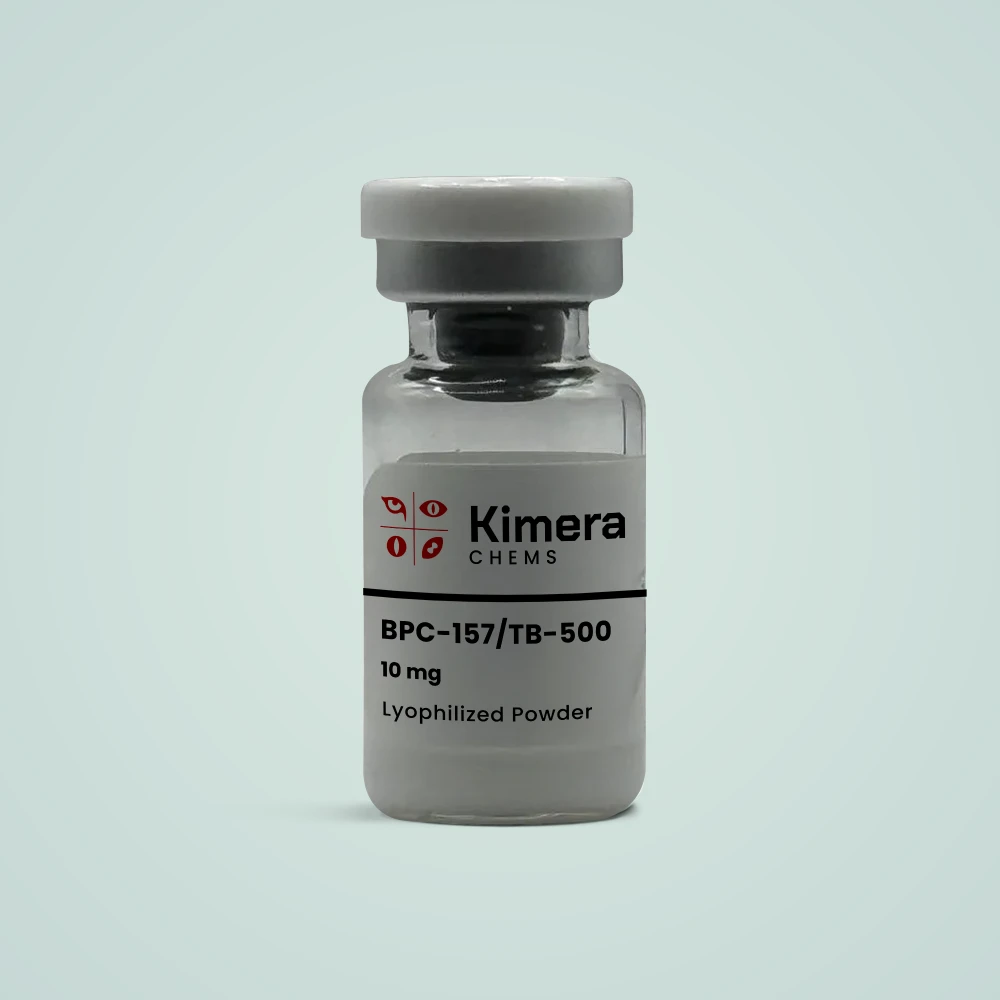
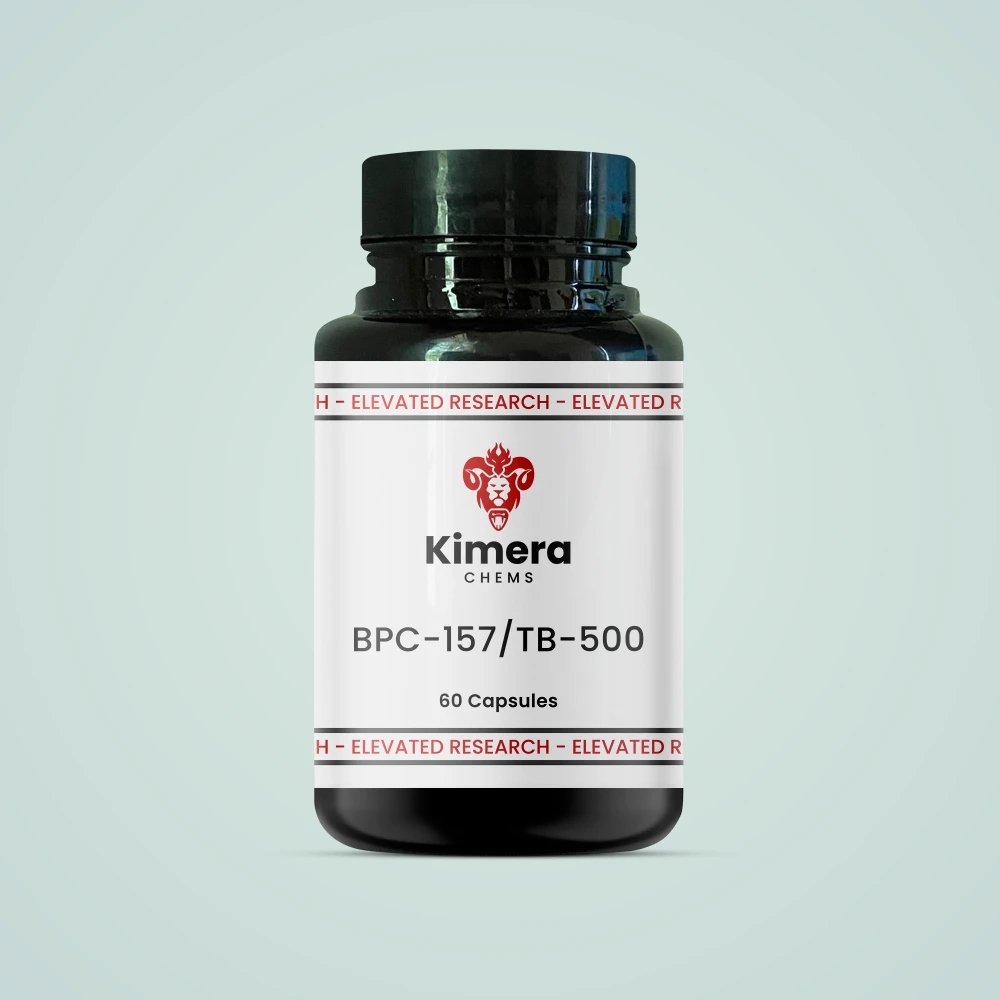
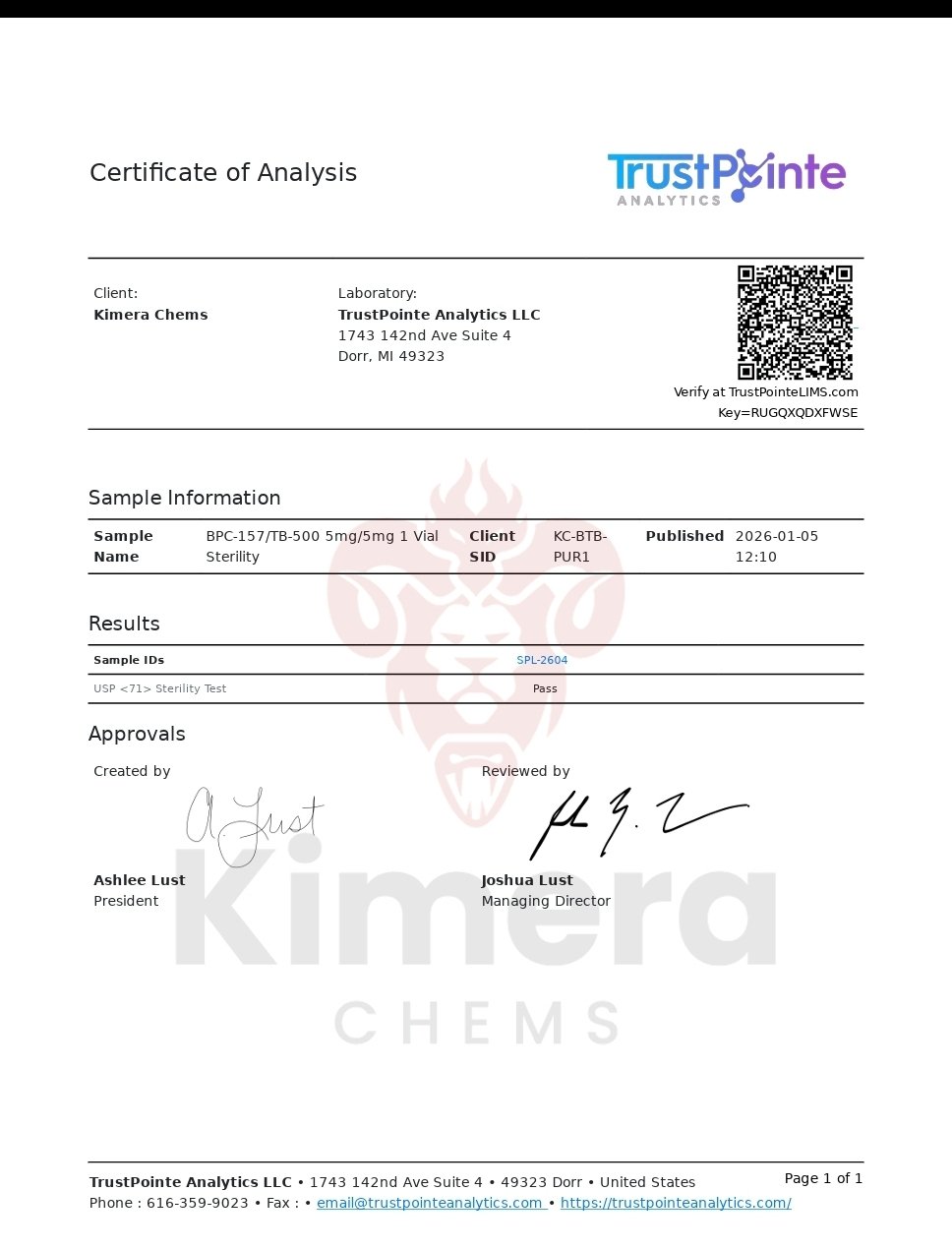
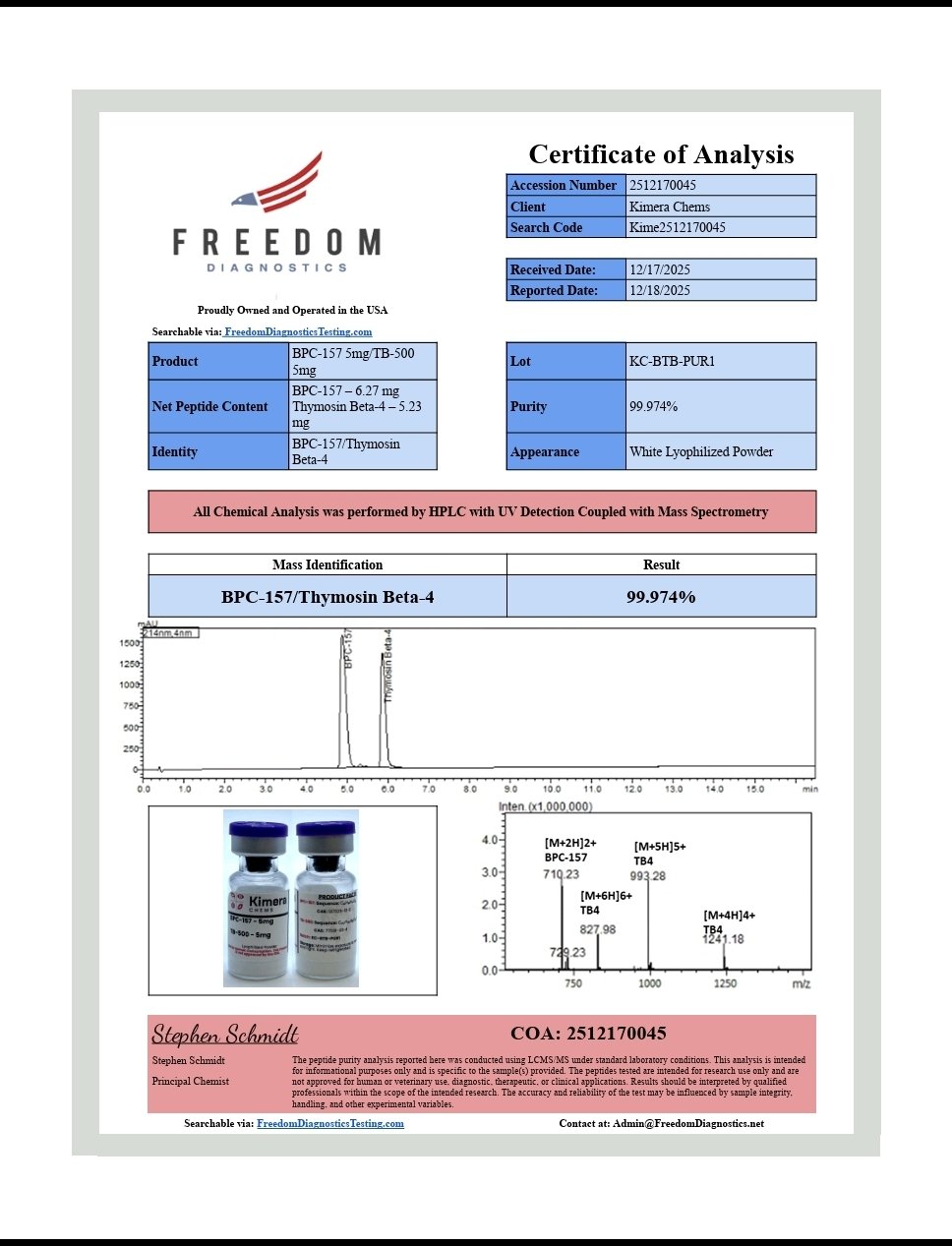
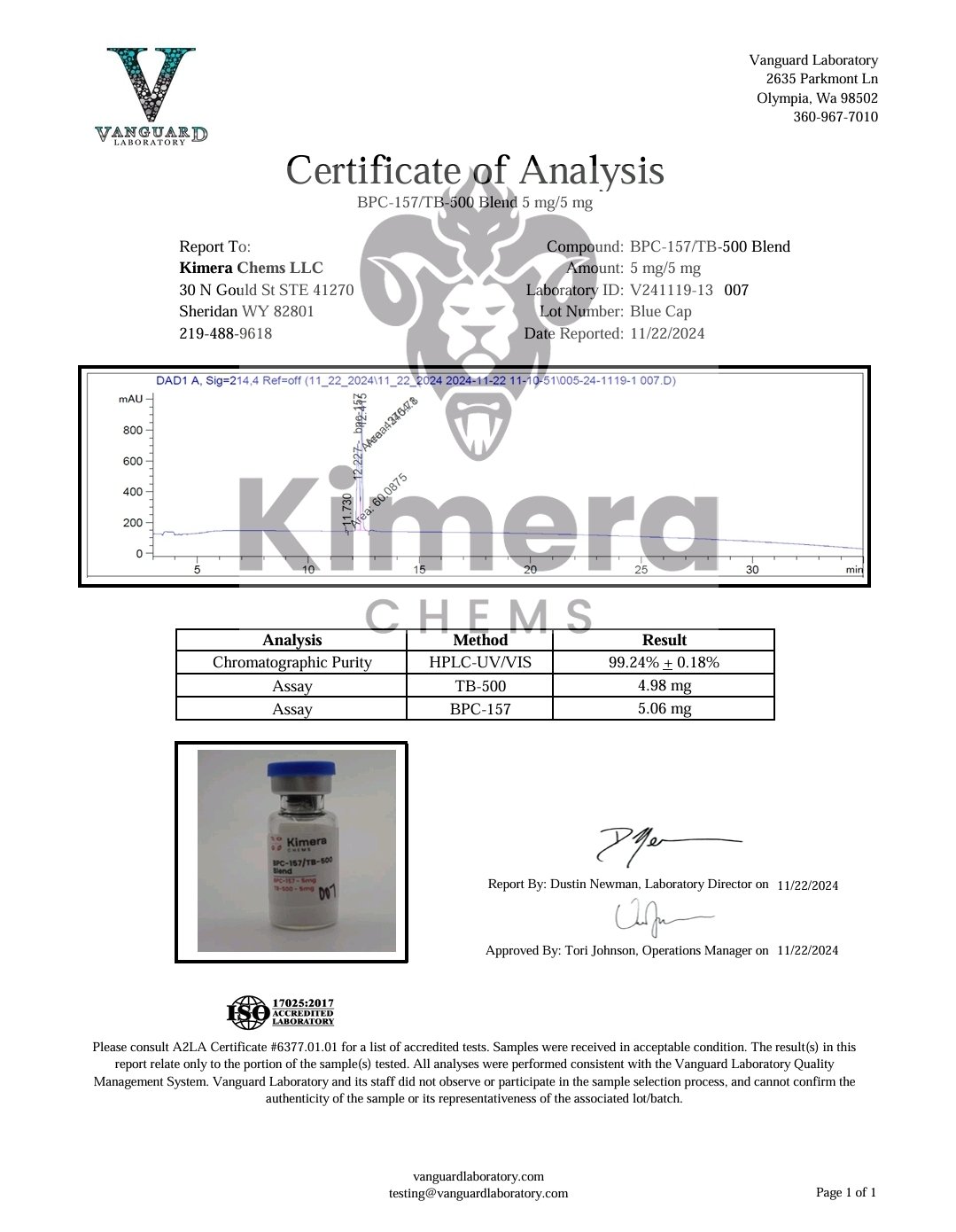
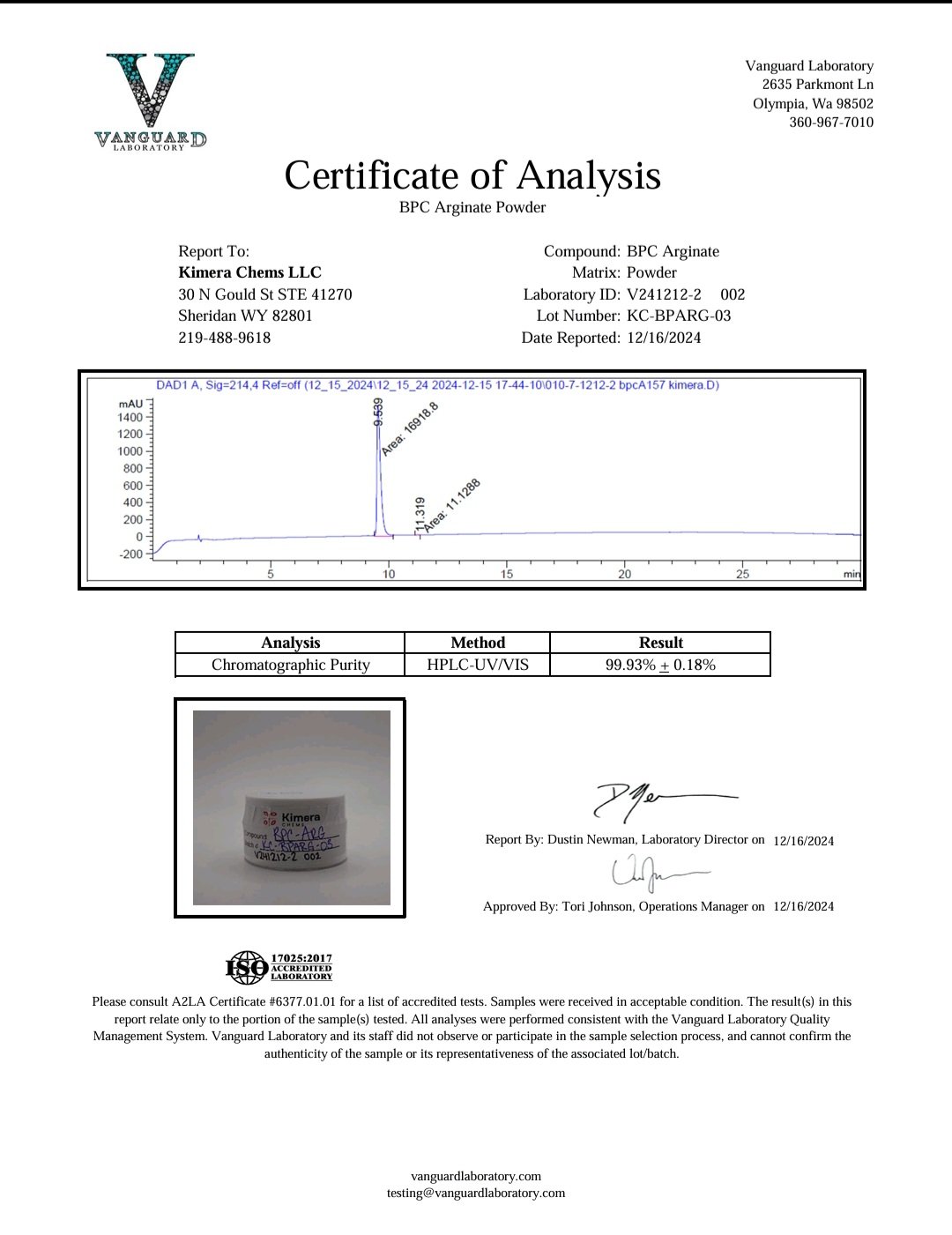
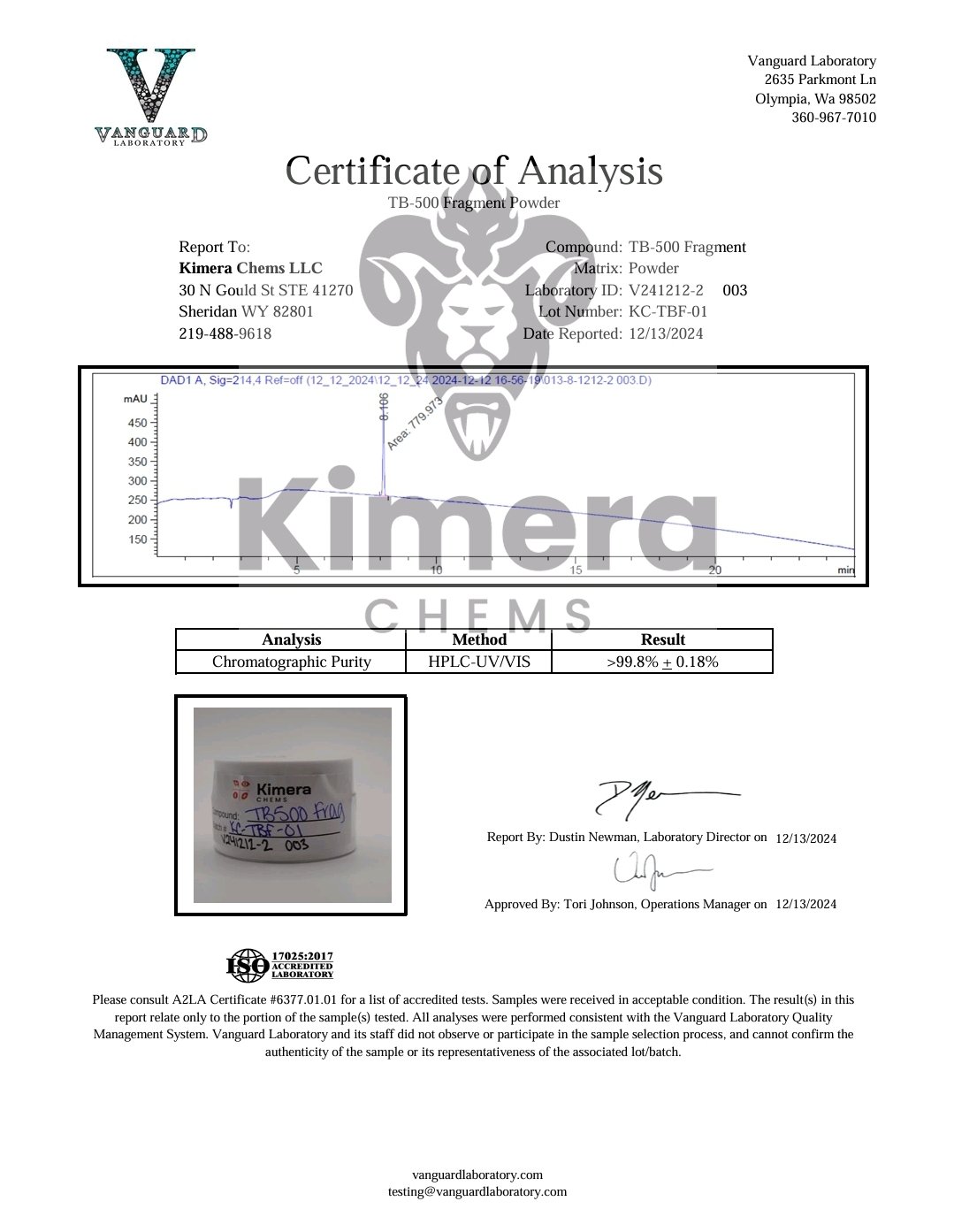

BPC-157/TB-500 blend is used for scientific research. This product is a lyophilized combination of two synthetic peptides. This formulation is classified as a multi-component research peptide blend. Investigators use this blend to study concurrent signaling pathways in laboratory models. Scientists analyze the peptides together in single in vitro systems. This allows for the examination of different molecular mechanisms simultaneously. Research focuses on the individual and combined interactions of each peptide. The blend is a tool for complex cellular communication studies.
Chemical Composition & Purity
The BPC-157/TB-500 blend is supplied as a co-lyophilized powder. The final product is a homogeneous, white-to-off-white solid.
- BPC-157 Component: It is a pentadecapeptide. Its molecular formula is C₆₂H₉₈N₁₆O₂₂.
- TB-500 Component: It is a synthetic version of Thymosin β4. Its molecular formula is C₂₁₂H₃₅₀N₅₆O₇₈S.
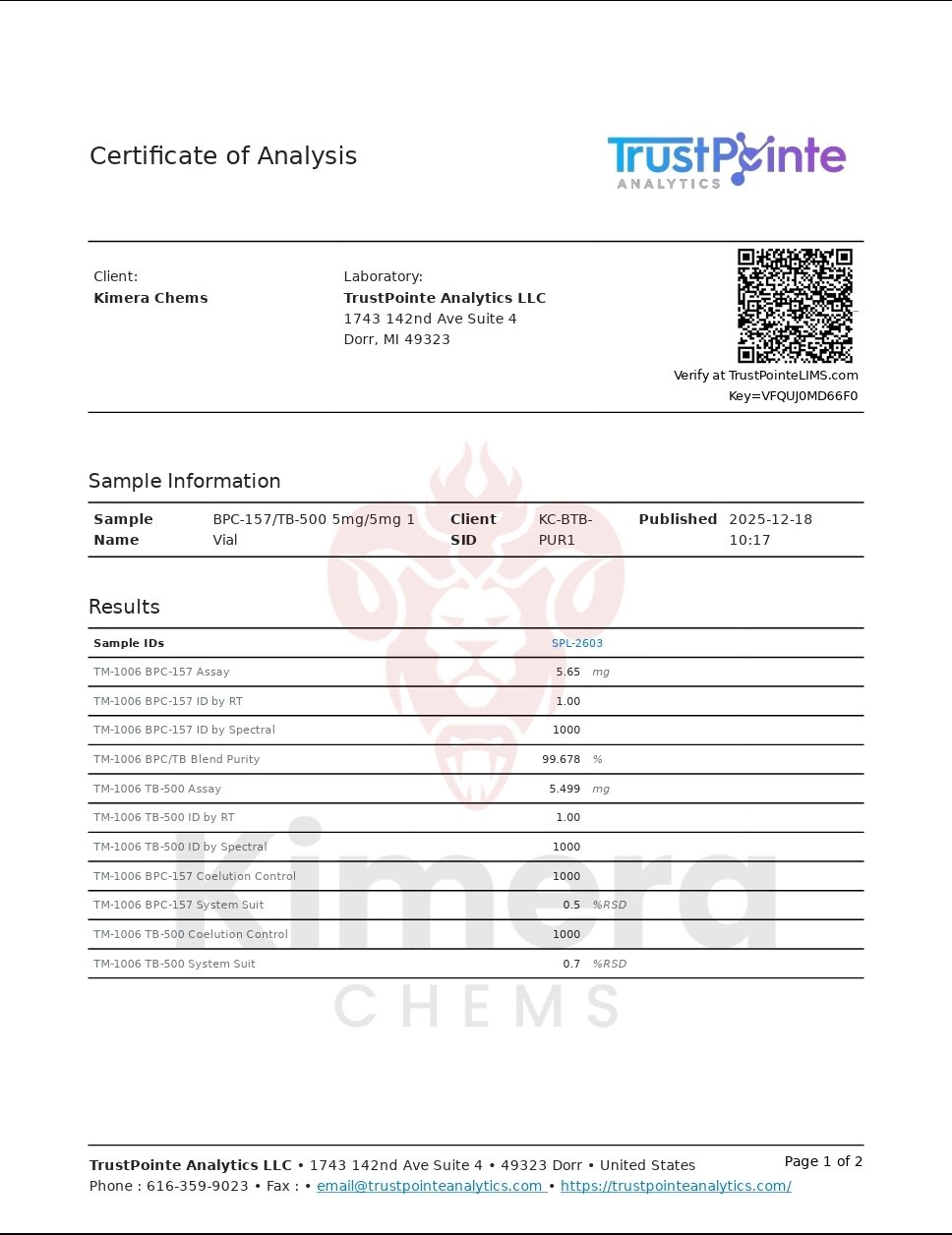
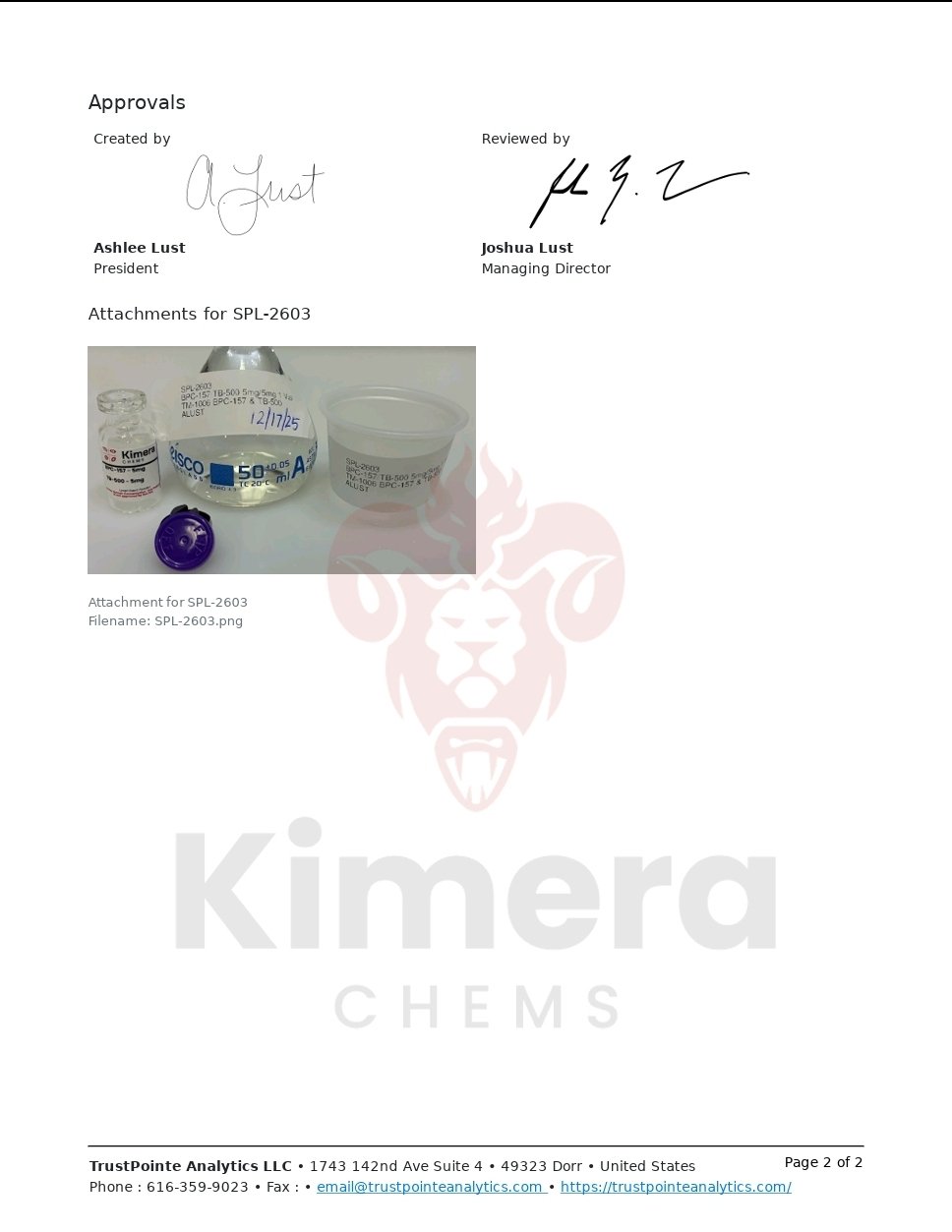
The blend is created by combining purified BPC-157 and TB-500 in a specific, documented mass ratio. Kimera Chems verifies each component separately before the blending process. High-performance liquid chromatography (HPLC) confirms the identity and purity of each peptide. The final blended powder is analyzed to ensure homogeneity and consistent composition. This guarantees reliable and reproducible material for research.
Research Applications
This peptide blend is used in research models requiring multi-pathway analysis. Scientists study BPC-157 for its potential interaction with growth factor and nitric oxide pathways. Researchers study TB-500 for its association with actin cytoskeleton dynamics and cell motility. Using both peptides together allows for the analysis of these distinct mechanisms in parallel.
- Parallel Pathway Analysis: Studying two signaling mechanisms concurrently.
- Cell Migration Models: Use in combined scratch or wound healing assays.
- Cytoskeletal Interaction Studies: Analyzing actin dynamics with other pathways.
- Synergistic Effect Research: Examining potential combined molecular actions.
- In Vitro Model Validation: Application in complex tissue culture systems.
Storage & Handling Protocol
Proper storage is critical to maintain the chemical integrity of the peptide blend. Researchers must follow these guidelines to prevent molecular degradation.
- Lyophilized peptides can be kept at room temperature, away from direct light.
- If reconstituted, the sample should be kept in the fridge.
- For long-term storage, the material must be stored in the freezer.
- Keep in a tightly sealed container with desiccant.
- Store in an amber vial or opaque container.
- Use sterile buffers and technique if needed.
Compliance & Usage Disclaimer
This product is for Research Use Only (RUO). It is a chemical blend for non-clinical laboratory analysis. It is not for human or animal consumption. It is not a medication, nutritional supplement, or cosmetic.
Availability & Research Sourcing
Kimera Chems formulates highly specific peptide blends for advanced research. We provide this BPC 157 TB500 blend to qualified scientific institutions. Researchers can source this product for studies involving concurrent pathway investigation.
Specification Set 1
| CAS Number | 137525-51-0 (BPC-157) |
| Other Names | BPC-157 5mg/5mg |
| IUPAC Name | (4S)-4-[(2-aminoacetyl)amino]-5-[(2S)-2-[(2S)-2-[(2S)-2-[[2-[[(2S)-6-amino-1-[(2S)-2-[[(2S)-1-[[(2S)-3-carboxy-1-[[(2S)-3-carboxy-1-[[(2S)-1-[[2-[[(2S)-1-[[(1S)-1-carboxy-2-methylpropyl]amino]-4-methyl-1-oxopentan-2-yl]amino]-2-oxoethyl]amino]-1-oxopropan-2-yl]amino]-1-oxopropan-2-yl]amino]-1-oxopropan-2-yl]amino]-1-oxopropan-2-yl]carbamoyl]pyrrolidin-1-yl]-1-oxohexan-2-yl]amino]-2-oxoethyl]carbamoyl]pyrrolidine-1-carbonyl]pyrrolidine-1-carbonyl]pyrrolidin-1-yl]-5-oxopentanoic acid |
| Molecular Formula | C₆₂H₉₈N₁₆O₂₂ |
| Molecular Weight | 1419.5 |
Specification Set 2
| CAS Number | 77591-33-4 (TB-500) |
| Other Names | TB-500 |
| IUPAC Name | (4S)-4-[[2-[[(2S)-2-[[(2S)-2-[[(2S)-2-[[(2S)-2-[[(2S)-2-[[(2S)-2-[[(2S,3S)-2-[[(2S,3R)-2-[[(2S)-2-[[(2S)-2-[[(2S)-2-[[(2S)-1-[(2S)-2-[[(2S)-1-[(2S)-2-[[(2S)-2-[[(2S)-2-[[(2S)-2-[[(2S,3R)-2-[[(2S)-2-[[(2S,3R)-2-[[(2S)-2-[[(2S)-2-[[(2S)-2-[[(2S)-2-[[(2S)-2-[[(2S)-2-[[(2S)-2-[[(2S)-2-[[(2S)-2-[[(2S)-2-[[(2S,3S)-2-[[(2S)-2-[[(2S)-2-[[(2S)-2-[[(2S)-2-[[(2S)-1-[(2S)-2-[[(2S)-2-[[(2S)-2-acetamido-3-hydroxypropanoyl]amino]-3-carboxypropanoyl]amino]-6-aminohexanoyl]pyrrolidine-2-carbonyl]amino]-3-carboxypropanoyl]amino]-4-methylsulfanylbutanoyl]amino]propanoyl]amino]-4-carboxybutanoyl]amino]-3-methylpentanoyl]amino]-4-carboxybutanoyl]amino]-6-aminohexanoyl]amino]-3-phenylpropanoyl]amino]-3-carboxypropanoyl]amino]-6-aminohexanoyl]amino]-3-hydroxypropanoyl]amino]-6-aminohexanoyl]amino]-4-methylpentanoyl]amino]-6-aminohexanoyl]amino]-6-aminohexanoyl]amino]-3-hydroxybutanoyl]amino]-4-carboxybutanoyl]amino]-3-hydroxybutanoyl]amino]-5-amino-5-oxopentanoyl]amino]-4-carboxybutanoyl]amino]-6-aminohexanoyl]amino]-4-amino-4-oxobutanoyl]pyrrolidine-2-carbonyl]amino]-4-methylpentanoyl]pyrrolidine-2-carbonyl]amino]-3-hydroxypropanoyl]amino]-6-aminohexanoyl]amino]-4-carboxybutanoyl]amino]-3-hydroxybutanoyl]amino]-3-methylpentanoyl]amino]-4-carboxybutanoyl]amino]-5-amino-5-oxopentanoyl]amino]-4-carboxybutanoyl]amino]-6-aminohexanoyl]amino]-5-amino-5-oxopentanoyl]amino]propanoyl]amino]acetyl]amino]-5-[[(1S)-1-carboxy-2-hydroxyethyl]amino]-5-oxopentanoic acid |
| Molecular Formula | C₂₁₂H₃₅₀N₅₆O₇₈S |
| Molecular Weight | 4963 |