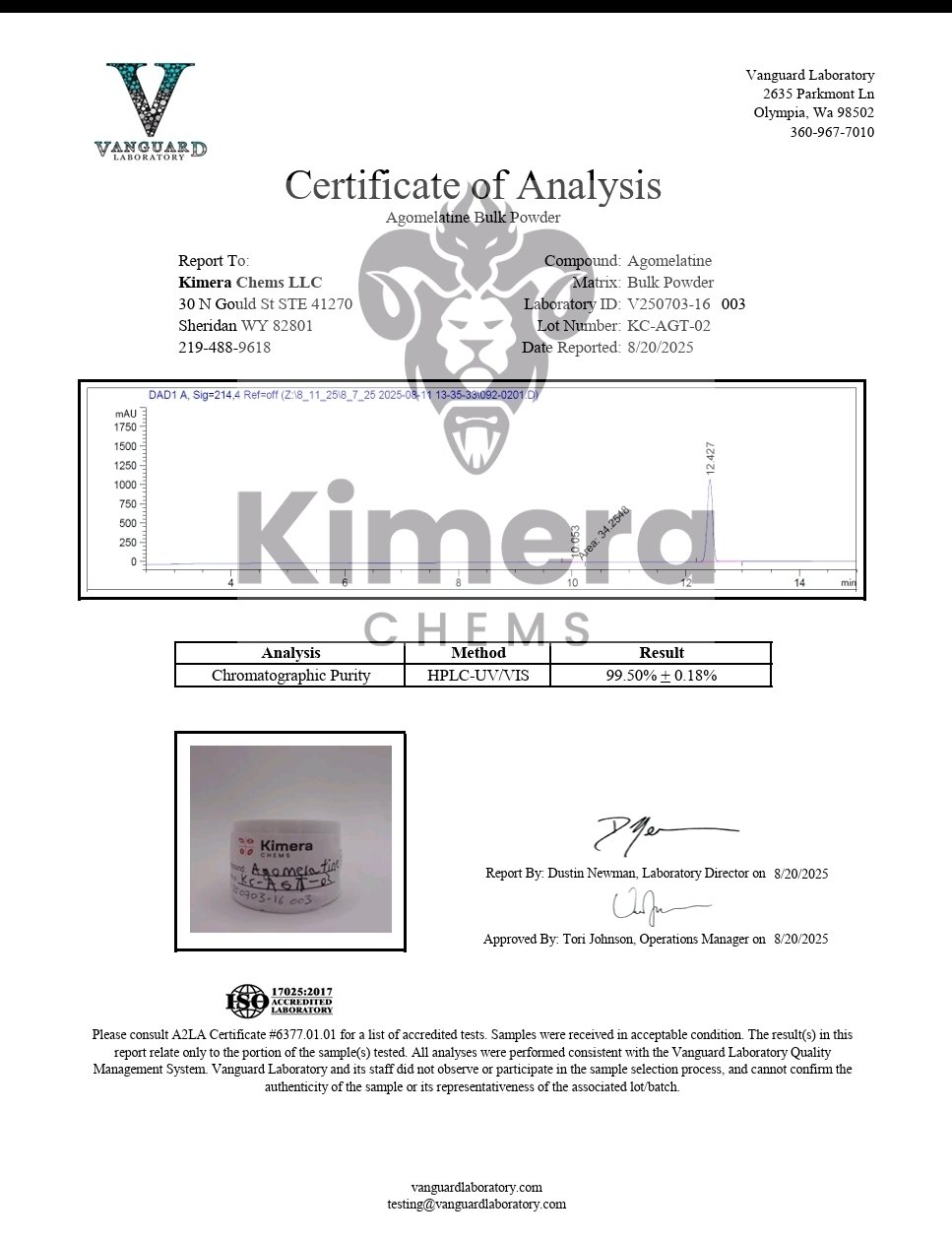
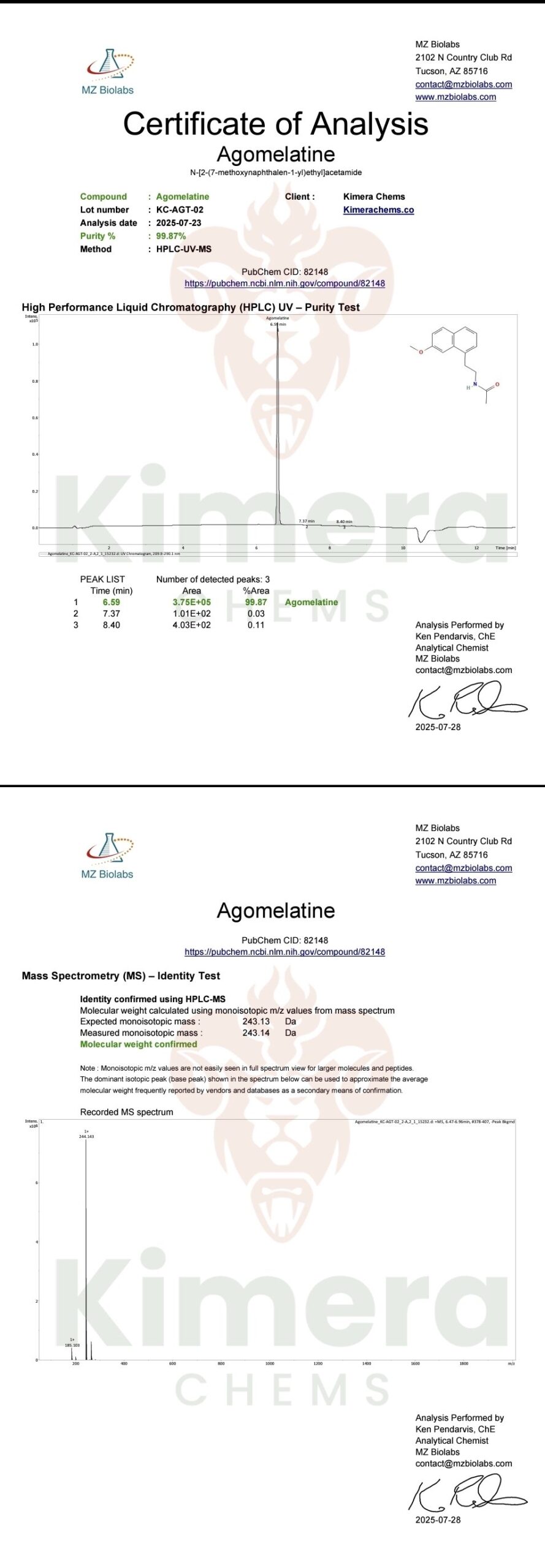

Agomelatine (Research Use Only)
Agomelatine is a synthetic naphthalene-based compound primarily studied for its interaction with melatonin receptors (MT1/MT2) and serotonin 5-HT₂C receptors. In research environments, it is used to investigate circadian rhythm regulation, sleep–wake signaling, monoaminergic modulation, and neurochemical timing mechanisms.
This compound is supplied strictly for laboratory and analytical research purposes and is not intended for human or veterinary use.
Chemical Identification
| Property | Value |
|---|---|
| Chemical Name | N-[2-(7-methoxy-1-naphthyl)ethyl]acetamide |
| Molecular Formula | C₁₅H₁₇NO₂ |
| Molecular Weight | 243.30 g/mol |
| CAS Number | 138112-76-2 |
| IUPAC Name | N-[2-(7-methoxynaphthalen-1-yl)ethyl]acetamide |
| Structure Class | Naphthalene derivative |
| Physical Form | White to off-white crystalline solid |
Mechanism of Action (Research Context)
Agomelatine exhibits a dual-pathway receptor profile, making it unique among circadian research compounds:
Melatonergic Activity
-
Acts as an agonist at MT1 and MT2 receptors
-
Used in research models examining circadian entrainment, phase shifting, and sleep architecture
Serotonergic Modulation
-
Functions as a 5-HT₂C receptor antagonist
-
Studied for downstream effects on dopaminergic and noradrenergic signaling, particularly in the prefrontal cortex
This combination allows researchers to explore chronobiology and neurotransmitter timing interactions in controlled experimental systems.
Physicochemical Properties
| Parameter | Description |
|---|---|
| Solubility | Low aqueous solubility; soluble in DMSO and organic solvents |
| LogP | ~2.7 (moderate lipophilicity) |
| Stability | Stable under dry, light-protected conditions |
| Melting Point | ~98–102 °C |
Research Applications
Agomelatine is commonly utilized in:
-
Circadian rhythm and chronopharmacology studies
-
Melatonin receptor binding assays
-
Sleep-wake cycle modeling
-
Neurotransmitter timing and signaling research
-
Receptor selectivity and pathway differentiation studies
Its receptor specificity makes it valuable for mechanistic separation of melatonergic vs serotonergic signaling in experimental systems.
Storage & Handling
-
Store in a cool, dry environment
-
Protect from light and moisture
-
Recommended storage temperature: 2–8 °C
-
Dissolve using appropriate laboratory-grade solvents (e.g., DMSO) prior to experimental use
Regulatory & Research Disclaimer
Agomelatine is sold for research use only (RUO).
Not intended for:
-
Human consumption
-
Veterinary use
-
Diagnostic or therapeutic applications
All handling should be performed by qualified personnel in compliance with applicable laboratory safety and regulatory standards.
Frequently Asked Questions
Is agomelatine a melatonin analog?
Structurally, it is a synthetic naphthalene derivative, not a direct melatonin analog, though it binds melatonin receptors.
What makes agomelatine unique in research?
Its combined MT1/MT2 agonism and 5-HT₂C antagonism allows dual-pathway investigation in circadian and monoaminergic systems.
Is agomelatine water-soluble?
No. It has poor aqueous solubility and requires organic solvents for preparation in laboratory settings.
| CAS Number | 138112-76-2 |
| Other Names | Thymanax, Valdoxan, 138112-76-2, N-(2-(7-Methoxynaphthalen-1-yl)ethyl)acetamide, S20098, S-20098, Melitor, AGO-178, AGO 178, CHEMBL10878, UNII-137R1N49AD |
| IUPAC Name | N-[2-(7-methoxynaphthalen-1-yl)ethyl]acetamide |
| Molecular Formula | C₁₅H₁₇NO₂ |
| Molecular Weight | 243.3 |
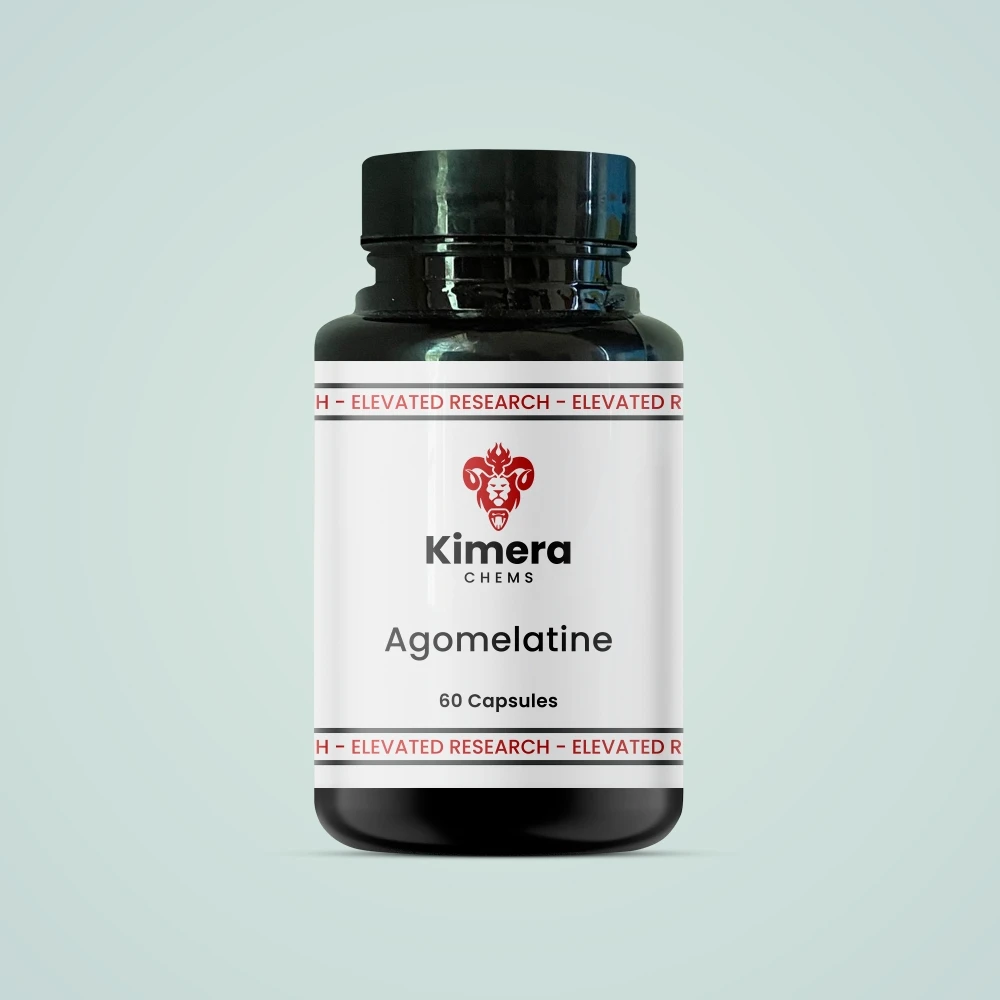
| Dry-Fill Capsule Concentration | 25mg |
| Liquid Concentration And Solution | NA |
| Aliquot Concentration And Solution | NA |