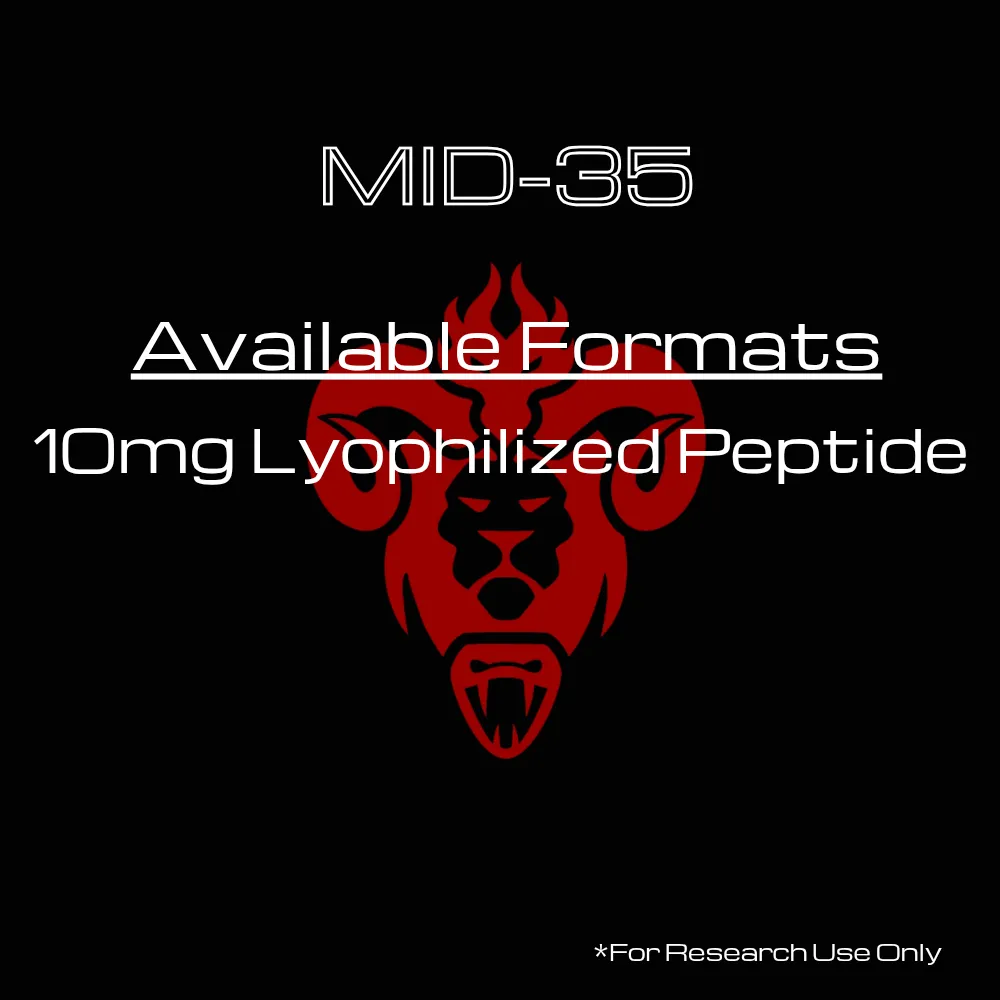

MID-35 — Myostatin Inhibitory D-Peptide
What Is MID-35?
MID-35 (CAS not yet assigned) is a 16-amino-acid synthetic D-peptide with the molecular weight of approximately 2,350 Da, designed to selectively inhibit myostatin (growth differentiation factor 8, GDF-8). It belongs to a class of retro-inverso peptides — compounds in which the amino acid sequence is reversed and all residues are configured in the D-form. This structural mirror-imaging preserves the spatial orientation of side chains necessary for target binding while conferring substantial resistance to proteolytic degradation. MID-35 was developed through iterative structure-activity relationship studies at Tokyo University of Pharmacy and Life Sciences and has been characterized across multiple peer-reviewed publications, including ACS Medicinal Chemistry Letters (2022), Cancer Science (2022), and Pharmaceuticals (2023).
MID-35 is sold for laboratory research use only. Not for human consumption, nor medical, veterinary, or household uses. Please familiarize yourself with our Terms and Conditions prior to ordering.
Mechanism of Action
Myostatin is a member of the TGF-β superfamily that functions as an endogenous negative regulator of skeletal muscle growth. It signals through the activin receptor type IIB (ActRIIB), recruiting type I receptors (ALK4/ALK5) and activating downstream Smad2/3 phosphorylation, which suppresses myogenic gene transcription and limits muscle fiber development. MID-35 blocks this pathway by binding myostatin at its activin type I receptor binding site, preventing Smad2/3 signaling activation. Because it targets the myostatin-receptor interface directly, MID-35 achieves selective inhibition without broadly neutralizing other TGF-β superfamily ligands such as activin A, GDF-11, or BMP9/10. This selectivity profile distinguishes it from decoy receptor approaches and broad-spectrum inhibitors like follistatin.
MID-35 demonstrates an IC50 of 0.19 μM in Smad-responsive luciferase reporter assays, making it approximately 20 times more potent than its predecessor compound (peptide-2, IC50 = 4.1 μM). In direct comparison with its L-peptide counterpart MIPE-1686, MID-35 shows equivalent in vitro inhibitory activity but significantly enhanced in vivo potency — a result attributed to its dramatically superior enzymatic stability. In trypsin degradation assays, MID-35 maintained structural integrity well beyond the degradation point of MIPE-1686.
Published Research
MID-35 has been evaluated in three published preclinical studies. In the initial development study (Takayama et al., 2022), a single intramuscular injection of MID-35 at 0.75 mM in 40 μL saline into the tibialis anterior muscle of 8-week-old male C57BL/6J mice produced a statistically significant 1.25–1.3-fold increase in muscle weight after 28 days. MID-35 significantly outperformed the L-peptide predecessor MIPE-1686 under identical conditions.
In a cancer cachexia model (Hanada et al., 2022), intramuscular MID-35 administration alleviated skeletal muscle atrophy in Lewis lung carcinoma-bearing mice, increasing muscle fiber cross-sectional area, reducing Smad2/3 nuclear translocation, and improving grip strength. When combined with anamorelin, a ghrelin receptor agonist, MID-35 further increased food intake, maximized grip strength, and extended survival, demonstrating synergistic benefit across multiple cachexia endpoints.
A third study (Michiue et al., 2023) explored non-invasive delivery of MID-35 via iontophoresis, a transdermal drug delivery technology using weak electrical current. Iontophoresis-delivered MID-35 successfully reached skeletal muscle from the skin surface and increased tibialis anterior mass by 1.25-fold, with corresponding modulation of downstream muscle growth and atrophy gene expression including MyoD, Atrogin-1, and MuRF-1.
Chemical and Physical Properties
MID-35 presents as a white to off-white lyophilized powder. It is a 16-mer retro-inverso peptide derived from positions 28–43 of the mouse myostatin prodomain, with an arginine-containing modification that contributes to its inhibitory potency. The molecular weight is approximately 2,350 Da. The compound is freely soluble in water, PBS, and saline. MID-35 features β-sheet propensity in its secondary structure, which is associated with effective myostatin binding in this peptide class. Its D-amino acid composition confers resistance to standard proteolytic enzymes, distinguishing it from conventional L-peptide research tools in this pathway.
Storage and Handling
MID-35 is chemically stable in lyophilized form due to its D-amino acid composition but should be stored properly to maintain integrity. Upon receipt, researchers should store vials at -20°C protected from light and moisture for long-term stability. Reconstituted solutions should be stored at 2–8°C and used within 14 days. Reconstitution in bacteriostatic water or sterile 0.9% saline is recommended for research use. Researchers should minimize the number of freeze-thaw cycles for reconstituted material and aliquot as needed for experimental protocols.
Why Researchers Choose Kimera Chems
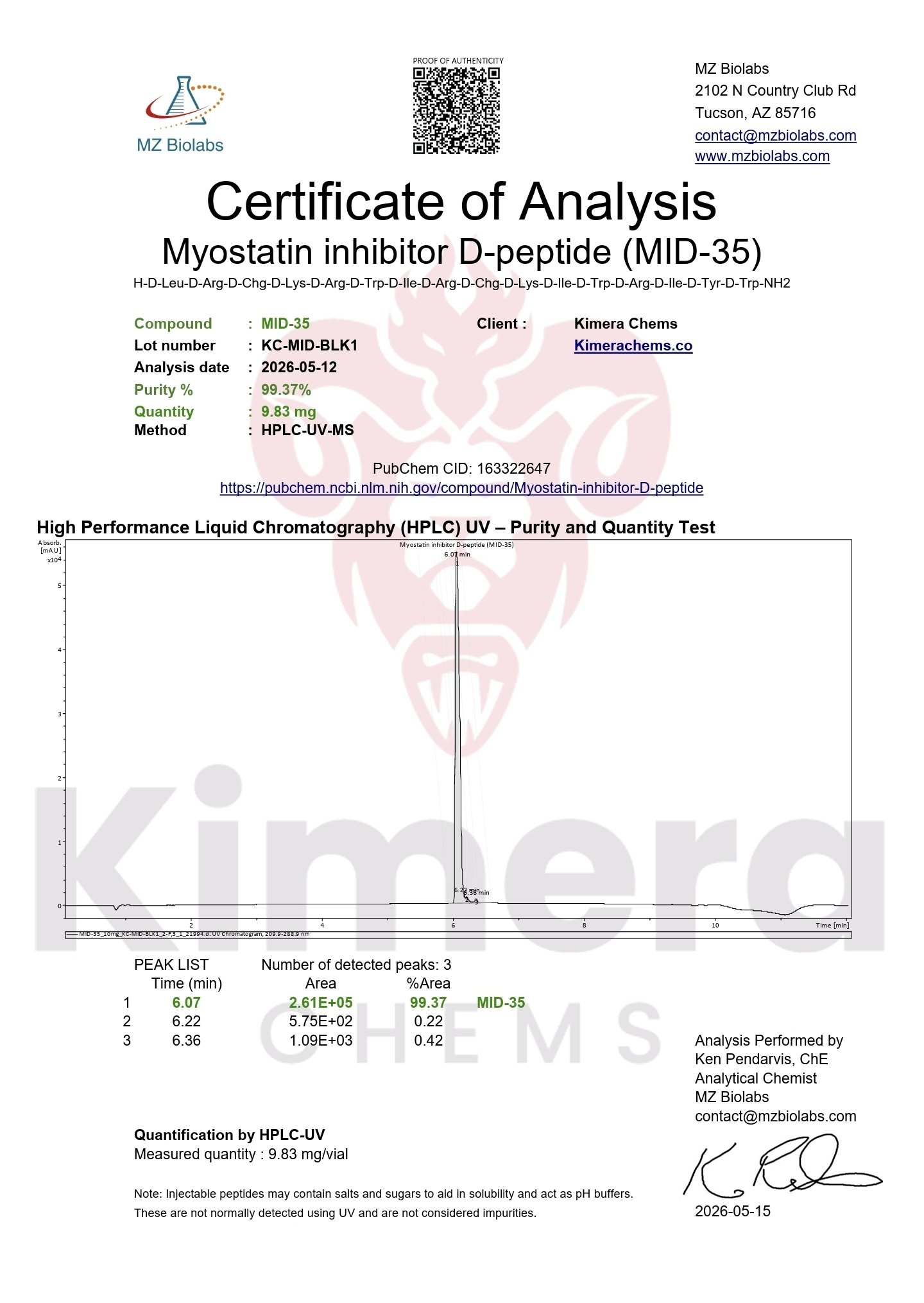
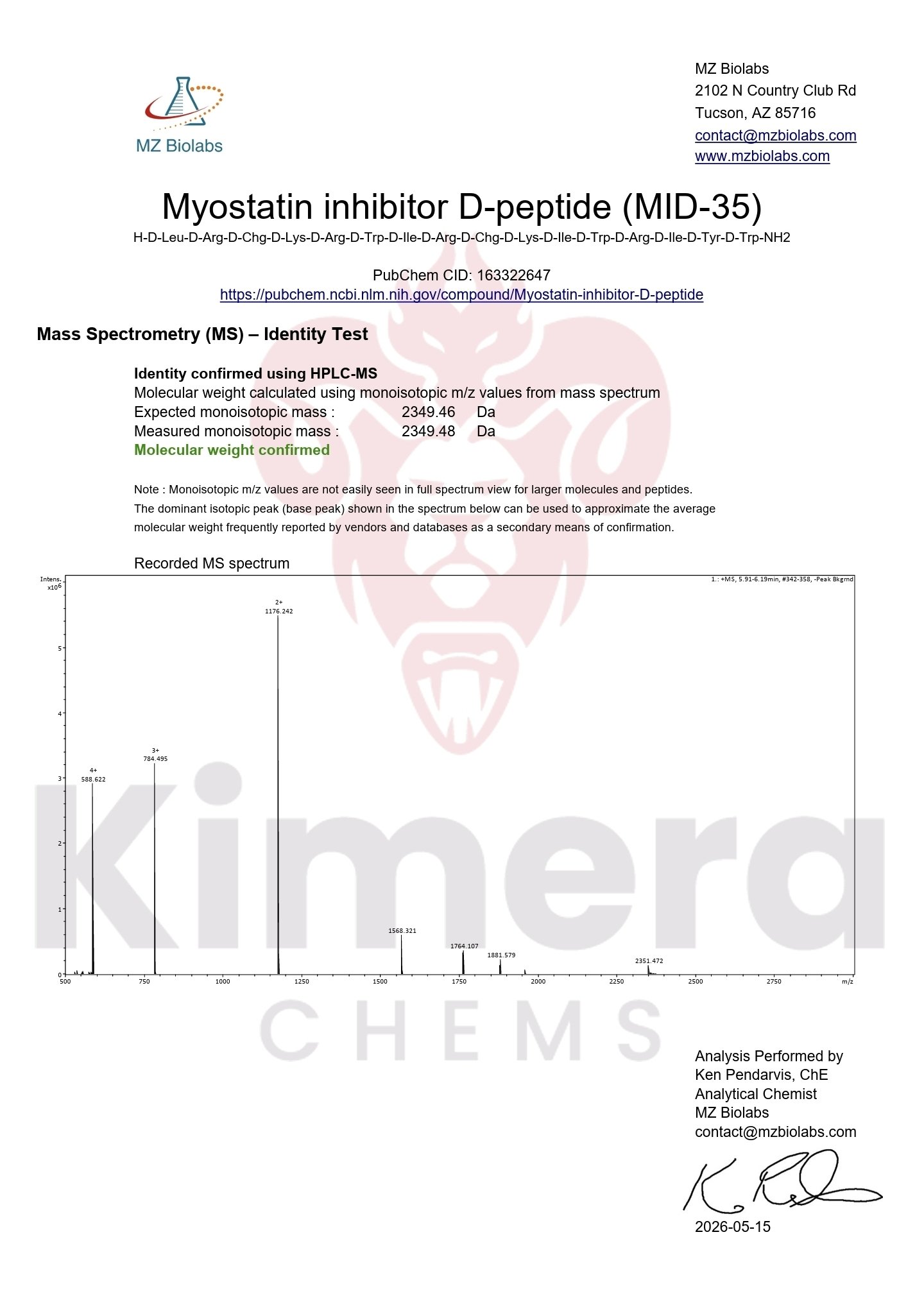
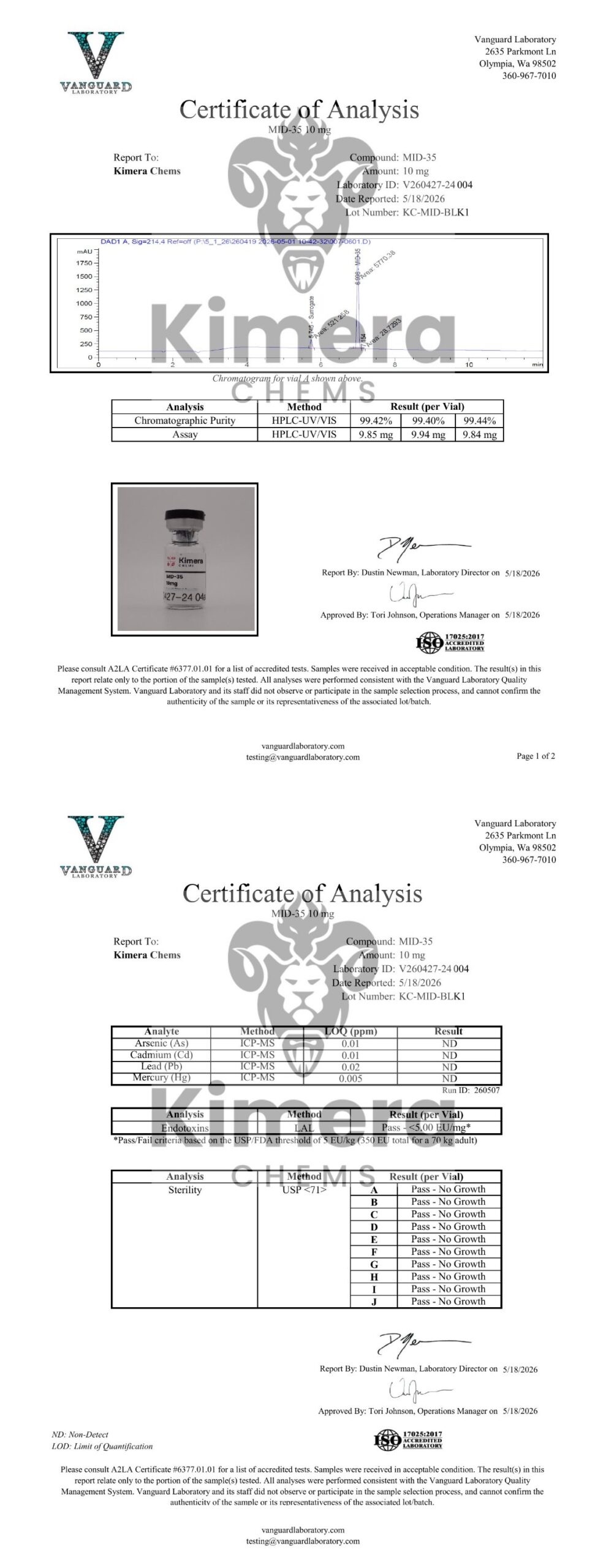
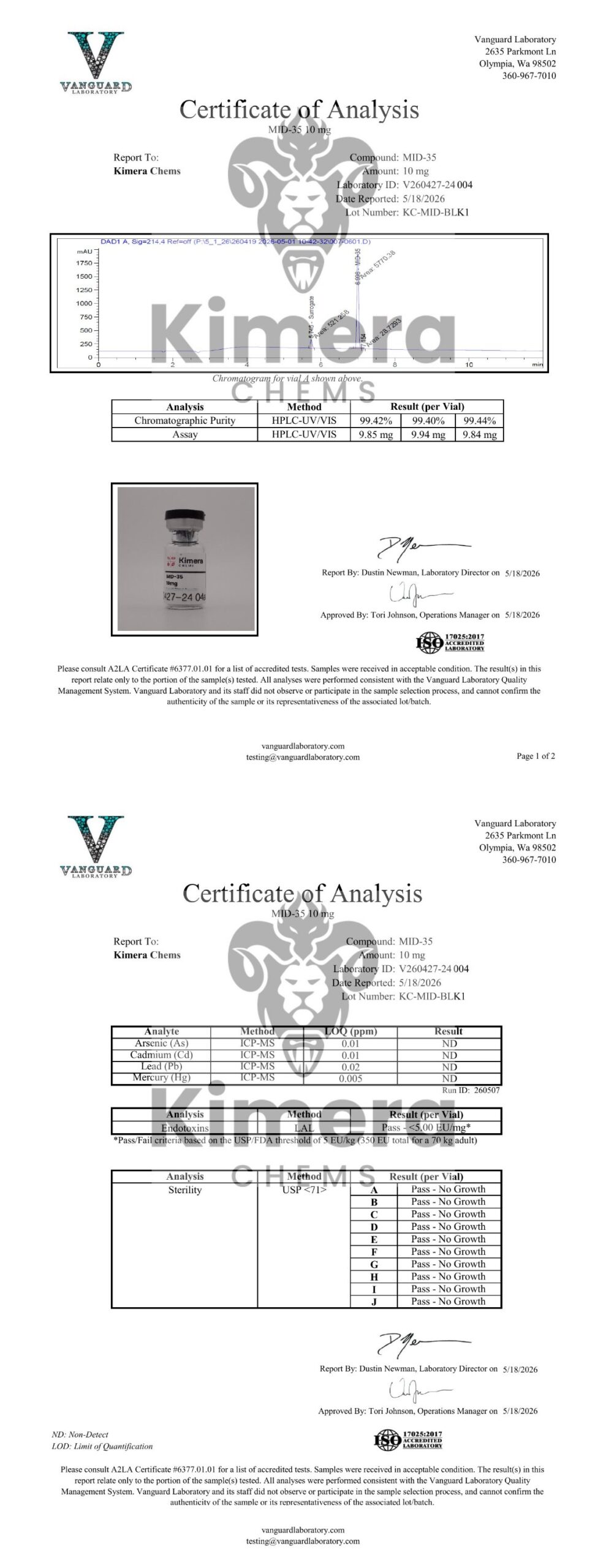
Every batch of MID-35 available through Kimera Chems is third-party tested for identity and purity via HPLC and mass spectrometry. Certificates of analysis (COAs) are available upon request. All products ship from the United States with fast domestic fulfillment.
References
- Takayama K, et al. Development of Myostatin Inhibitory d-Peptides to Enhance the Potency, Increasing Skeletal Muscle Mass in Mice. ACS Med. Chem. Lett. 2022;13(3):492–498.
- Hanada K, et al. Combination therapy with anamorelin and a myostatin inhibitor is advantageous for cancer cachexia in a mouse model. Cancer Sci. 2022;113(11):3766–3779.
- Michiue K, et al. Increasing Skeletal Muscle Mass in Mice by Non-Invasive Intramuscular Delivery of Myostatin Inhibitory Peptide by Iontophoresis. Pharmaceuticals. 2023;16(3):397.
- Walpurgis K, et al. Myostatin inhibitory peptides in sports drug testing. Drug Test. Anal. 2023;15(11-12):1477–1487.
Disclaimer
This product is sold strictly for in vitro research and educational purposes. It is not intended for human or animal consumption. MID-35 is not a dietary supplement, food, or drug. By purchasing this product, the buyer agrees to use it only in lawful research applications and assumes full responsibility for compliance with all applicable local, state, and federal regulations. Kimera Chems makes no therapeutic or diagnostic claims regarding this compound.
| CAS Number | N/A |
| IUPAC Name | D-Leucyl-D-arginyl-2-cyclohexyl-D-glycyl-D-lysyl-D-arginyl-D-tryptophyl-D-isoleucyl-D-arginyl-2-cyclohexyl-D-glycyl-D-lysyl-D-isoleucyl-D-tryptophyl-D-arginyl-D-isoleucyl-D-tyrosyl-D-tryptophanamide. |
| Molecular Formula | C118H184N34O17 |
| Molecular Weight | 2350.9 |