
Emoxypine Succinate
Emoxypine succinate is a synthetic derivative of 3-hydroxypyridine combined with succinic acid. Structurally analogous to pyridoxine (Vitamin B6), emoxypine succinate has been the subject of extensive preclinical investigation for its antioxidant, membranotropic, and neuroprotective properties. Originally synthesized in the early 1980s at the Research Institute of Pharmacology of the Russian Academy of Medical Sciences, this compound has generated significant interest across multiple areas of in vitro and in vivo research.
All Kimera Chems products are sold strictly for research use only (RUO) and are not intended for human consumption.
Compound Profile
Emoxypine succinate consists of two functionally significant components: 2-ethyl-6-methyl-3-hydroxypyridine and succinic acid. The hydroxypyridine moiety is responsible for the compound’s membranotropic and antioxidant characteristics, while the succinate component contributes to mitochondrial energy metabolism via the succinate oxidase FAD-dependent link of the Krebs cycle.
Also known as Mexidol, Mexiprim, Mexicor, and Emicidine in published literature.
CAS Number: 127464-43-1 Molecular Formula: C₁₂H₁₇NO₅ Molecular Weight: 255.27 g/mol IUPAC Name: butanedioic acid; 2-ethyl-6-methylpyridin-3-ol Appearance: White to off-white crystalline powder Solubility: Freely soluble in water and ethanol Storage: Store sealed at room temperature in a cool, dry environment away from direct light and moisture
Documented Research Areas
The published literature on emoxypine succinate spans several distinct areas of preclinical investigation.
Antioxidant and Free Radical Activity
Emoxypine and its succinate derivative have been characterized as inhibitors of free radical oxidation. Preclinical models have examined their capacity to suppress oxidative protein modification in ischemic tissue and reduce reactive oxygen species (ROS) production. The compound’s hydroxypyridine structure is believed to underlie these effects through direct interaction with lipid membranes.
Mitochondrial and Metabolic Activity
The succinate moiety of emoxypine succinate has been studied for its role in enhancing electron flow between mitochondrial enzyme complexes I and II (MEC I and MEC II). Under hypoxic or ischemic conditions, this mechanism has been observed to counteract the reduction of MEC I, thereby supporting ATP synthesis. This positions emoxypine succinate as a compound of interest in hypoxia-related metabolic research.
Iron Chelation
In vitro studies have documented iron chelating properties for emoxypine, suggesting potential relevance to research models involving excess iron accumulation. Phosphorylated and unphosphorylated derivatives have both demonstrated this activity in published assays, extending the compound’s applicability to hematological and neuroinflammatory research contexts.
Neuroprotective and BBB Penetration Research
Due to its relatively low molecular weight and structural properties, emoxypine succinate has been observed to penetrate the blood-brain barrier in preclinical distribution studies. Tissue analysis has shown measurable succinate concentrations in cerebral cortex samples following administration, making this compound relevant to CNS-targeted research designs. Additional preclinical work has explored its effects on conditioned reflex recovery following hippocampal lesioning and on CDK5/GSK3-beta and NLRP3 inflammatory pathways in iron overload-induced neuroinflammation models.
Cardioprotective and Vascular Research
Published preclinical data describe cardioprotective effects and improvements in cerebral microcirculation under experimental conditions. The compound’s dual mechanism — acting at both neuronal and vascular levels — has been noted in multiple reviews of the 3-hydroxypyridine research class.
Why Researchers Choose Kimera Chems
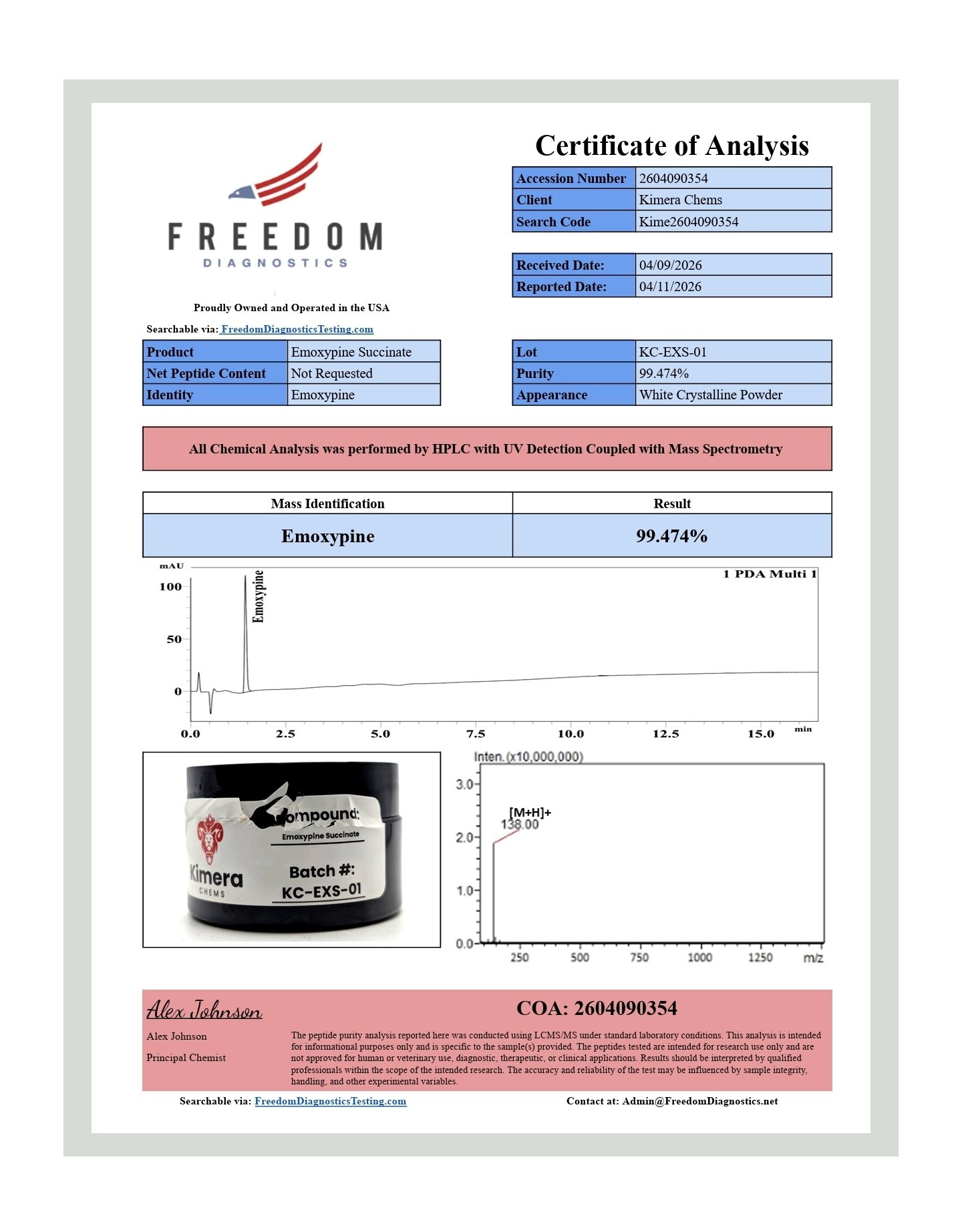
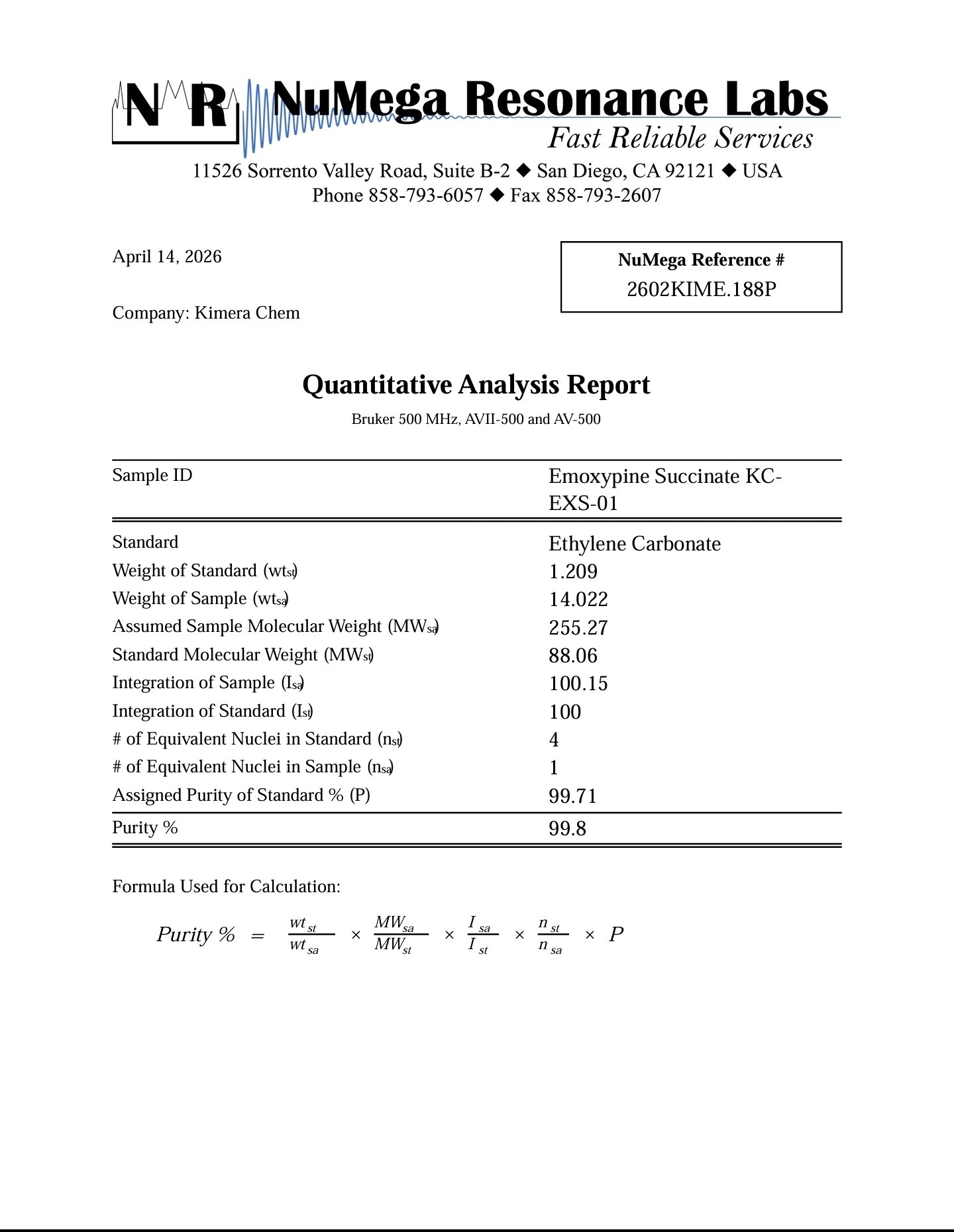
Every batch of emoxypine succinate sold by Kimera Chems is verified through our three-lab, third-party Certificate of Analysis (COA) pipeline. We utilize MZ Biolabs, Freedom Diagnostics, and NuMega Resonance Labs to ensure identity, purity, and consistency before any product reaches a researcher’s bench. Our commitment to analytical verification sets us apart from suppliers offering single-source or in-house-only testing.
Research Use Only Disclaimer
This product is sold exclusively for legitimate research purposes. Emoxypine succinate is not a dietary supplement, food additive, or pharmaceutical product. It is not intended to diagnose, treat, cure, or prevent any disease. By purchasing this product, you confirm that it will be used strictly in a research capacity by qualified individuals.
| CAS Number | 127464-43-1 |
| Other Names | Mexidol Succinate, Mexifin Succinate, UNII-2R985002CT, 2R985002CT, mexiprim, Emicidine |
| IUPAC Name | butanedioic acid;2-ethyl-6-methylpyridin-3-ol |
| Molecular Formula | C₈H₁₁NO |
| Molecular Weight | 137.18 |
| Dry-Fill Capsule Concentration | 125mg |