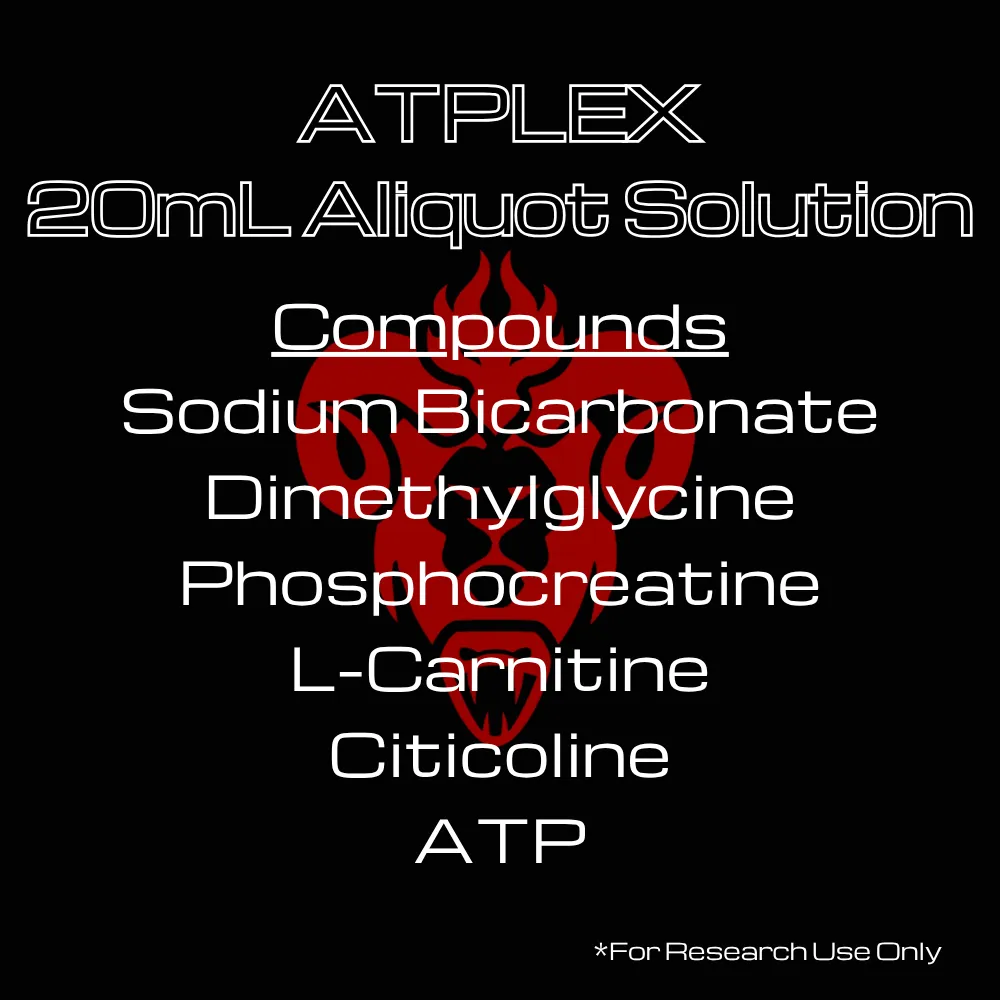
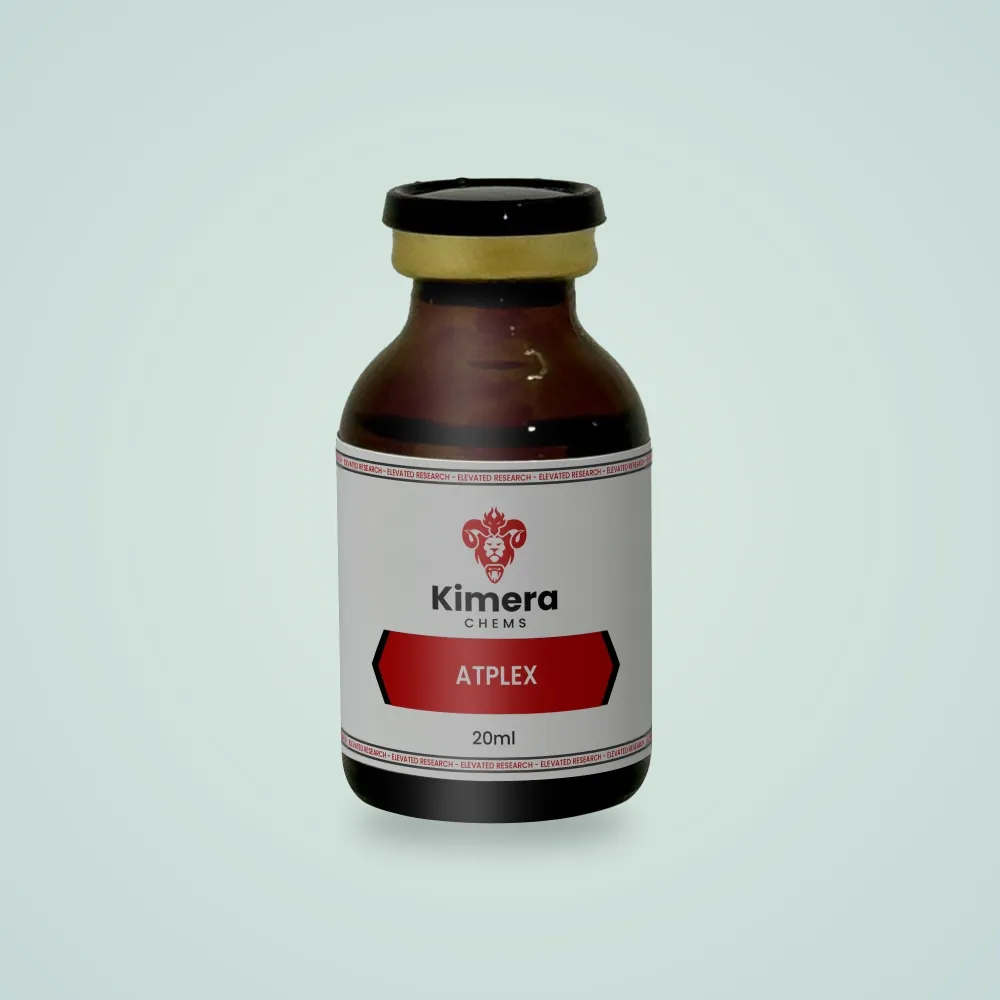

ATPLEX is a multi-component research solution. It contains several compounds combined in a sterile liquid format. Each component comes from a different chemical family.
- Sodium bicarbonate is an inorganic salt.
- Dimethylglycine is an amino acid derivative.
- Phosphocreatine is an energy storage molecule.
- L-Carnitine is an amino acid derivative.
- Citicoline is a nucleotide intermediate.
- ATP is a nucleoside triphosphate.
Researchers study this formulation for its chemical interactions. Each component has unique molecular properties. Scientists study how these compounds interact in solution. Kimera Chems supplies this product to authorized research facilities only.
Chemical Composition & Purity
This product is supplied as a 20 mL aliquot solution containing:
- Sodium Bicarbonate 7 mg
- Dimethylglycine 50 mg
- Phosphocreatine 50 mg
- L-Carnitine 75 mg
- Citicoline 90 mg
- ATP 10 mg
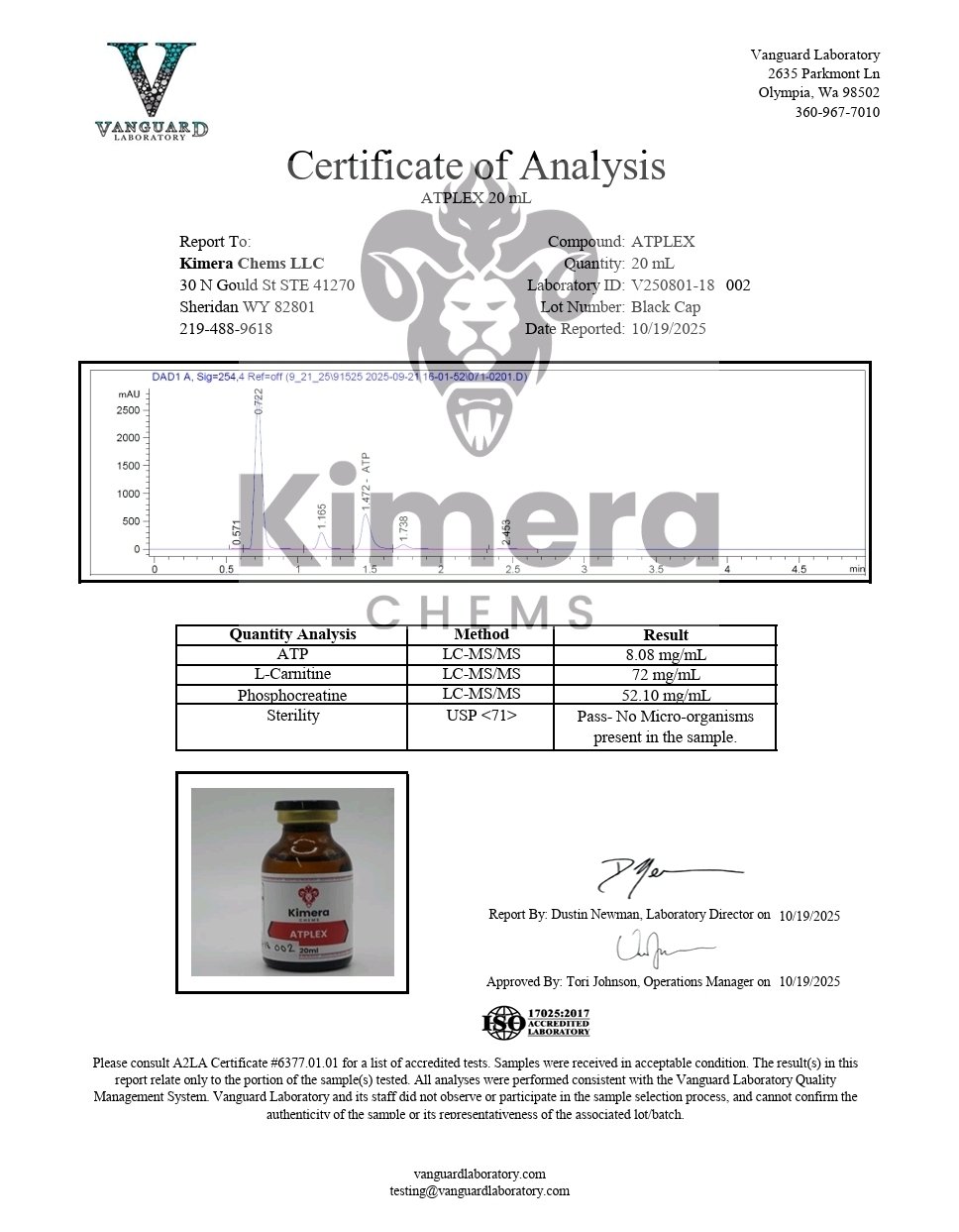
The solution uses sterile water with 1% benzyl alcohol as a preservative. Kimera Chems verifies each batch through third-party testing. The analysis is performed using high-performance liquid chromatography (HPLC), which confirms the components’ identity and purity.
Research Applications
Each compound in ATPLEX has functional groups that determine its chemical behavior.
- Sodium bicarbonate dissociates into sodium ions and bicarbonate ions in solution. Bicarbonate can accept or release protons, affecting pH.
- Dimethylglycine has a carboxyl group and a dimethylamino group. It can participate in ionic interactions.
- Phosphocreatine contains phosphate groups and a guanidino group. These carry negative charges at physiological pH.
- L-Carnitine has a carboxyl group and a quaternary ammonium group.
- Citicoline contains phosphate groups and a cytidine ring.
- ATP has three phosphate groups that carry multiple negative charges.
In solution, these compounds interact through ionic forces and hydrogen bonding. Researchers study these interactions in cell-free systems. They monitor the solubility, stability, and compatibility of the combined components.
- Solubility studies: Testing how components dissolve together.
- pH effects: Monitoring bicarbonate influence on solution acidity.
- Ionic interactions: Studying charge-based associations between compounds.
- Stability testing: Tracking degradation of each component over time.
Storage & Handling Protocol
Researchers need to store the ATPLEX solution properly to maintain its stability. You should follow these laboratory standards to ensure the blend remains stable for all experiments.
- Store the solution at 2-8°C.
- Protect the product from light.
- Make sure the container is tightly closed after each use.
- When working with the solution, use a sterile technique.
Compliance & Usage Disclaimer
This product is for Research Use Only (RUO). It is not for human or animal consumption. Any material offered as ATPLEX for sale on this site is strictly available for professional laboratory use.
Availability & Research Sourcing
Kimera Chems is a reliable provider of high-quality research compounds. You can buy ATPLEX and other chemical substances for your studies from our official website. We ensure that all of the products we provide meet the high standards of modern labs. Our team also provides complete analytical documentation with each batch. This way, we fulfill the technical and compliance needs of professional investigators.
No product specifications available.