
Kisspeptin-10 is a synthetic decapeptide. It represents the shortest functional sequence of the larger kisspeptin protein. This molecule is a key member of the RF-amide peptide family. In laboratory records, you often find it listed as KP-10 or Metastin (45-54). Researchers utilize this compound to investigate the Kiss1 receptor, also called GPR54. This receptor is a primary target in endocrine research. The peptide is studied for its role in the hypothalamic-pituitary-gonadal axis. Scientists use Kisspeptin-10 to explore how signals move through the central nervous system. It serves as a structural probe in many in vitro models. The compound helps investigators map the molecular architecture of reproductive signaling. By using this tool, labs can analyze receptor binding without the complexity of longer peptide chains. This material is produced strictly for laboratory experiments.
Chemical Composition & Purity
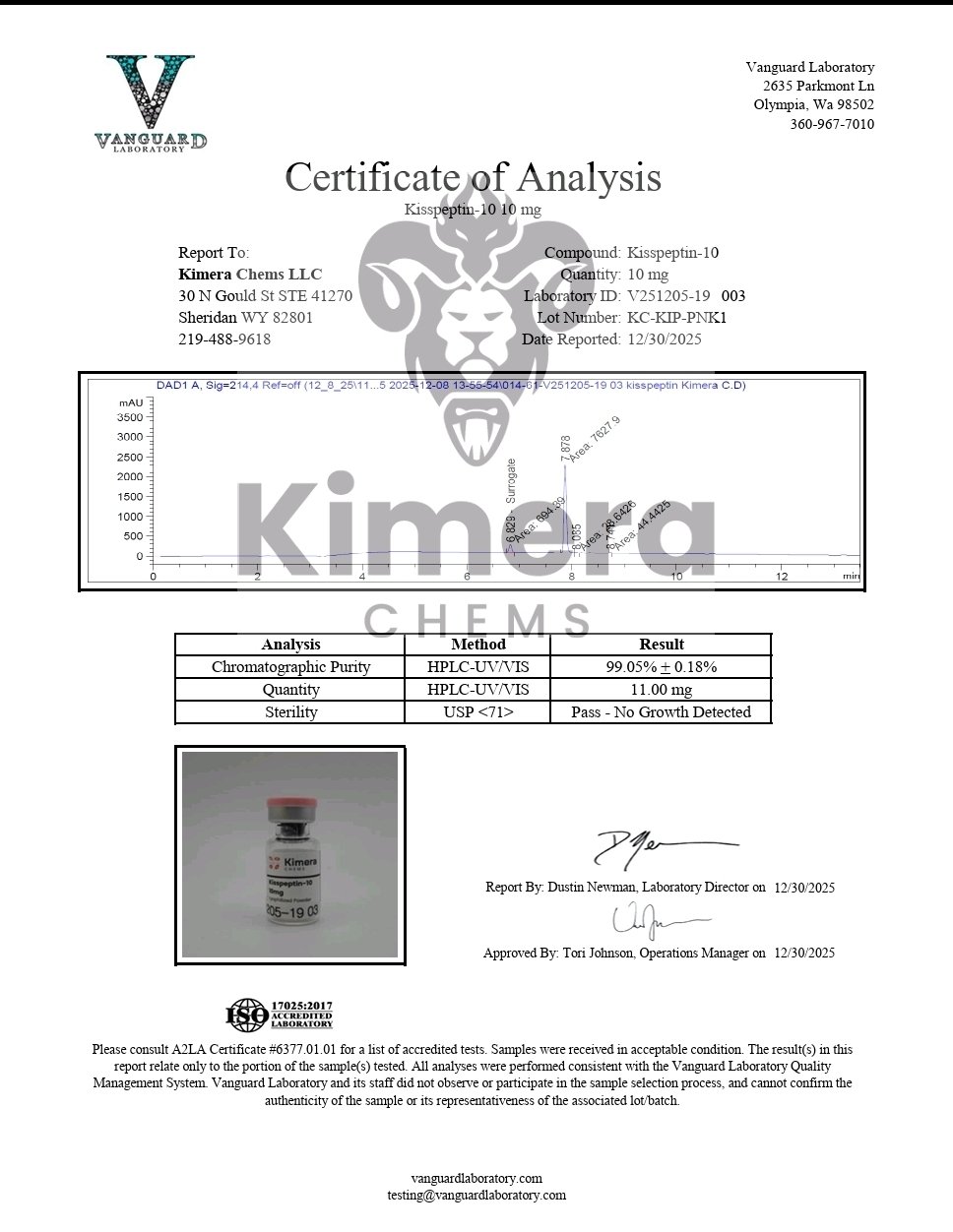
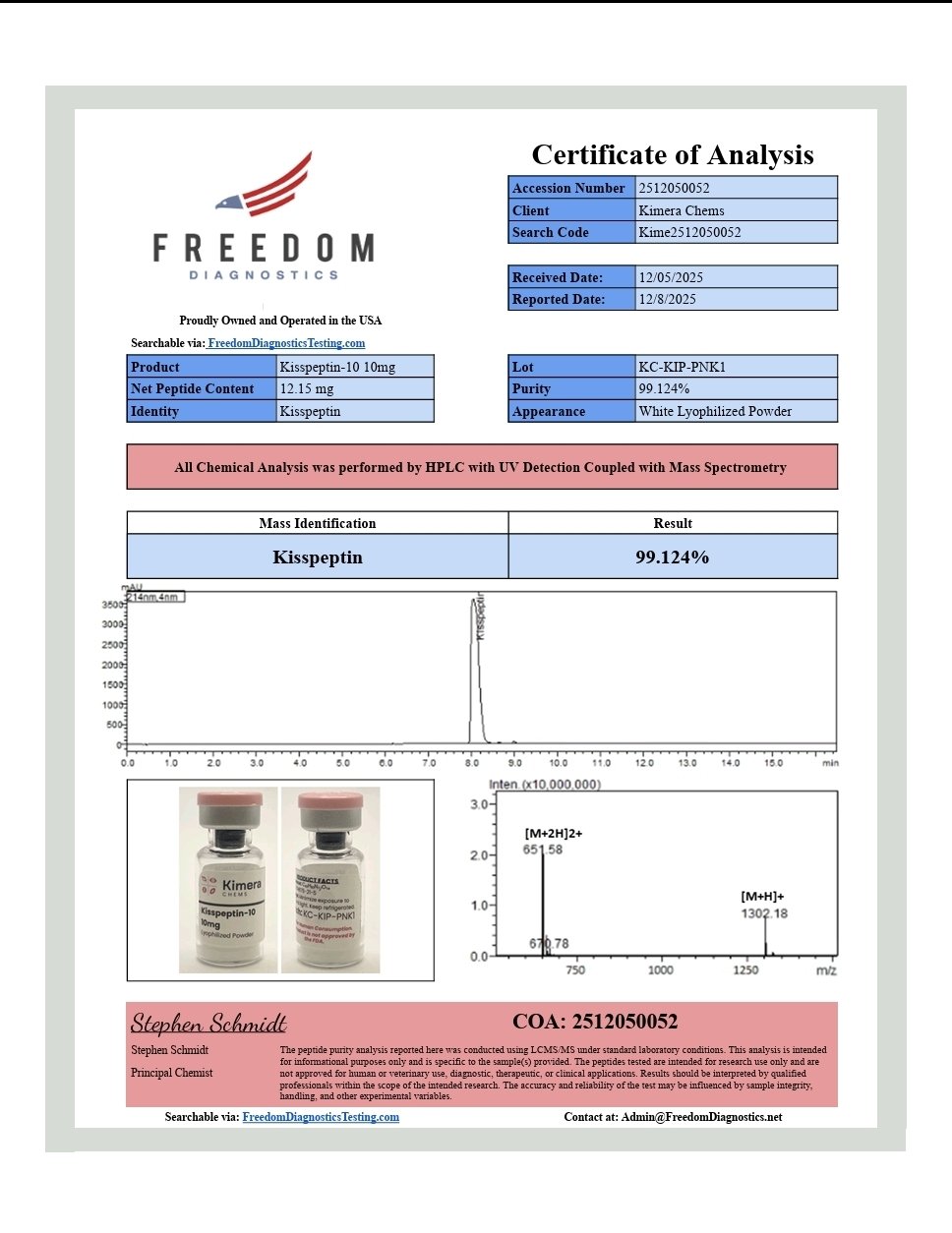
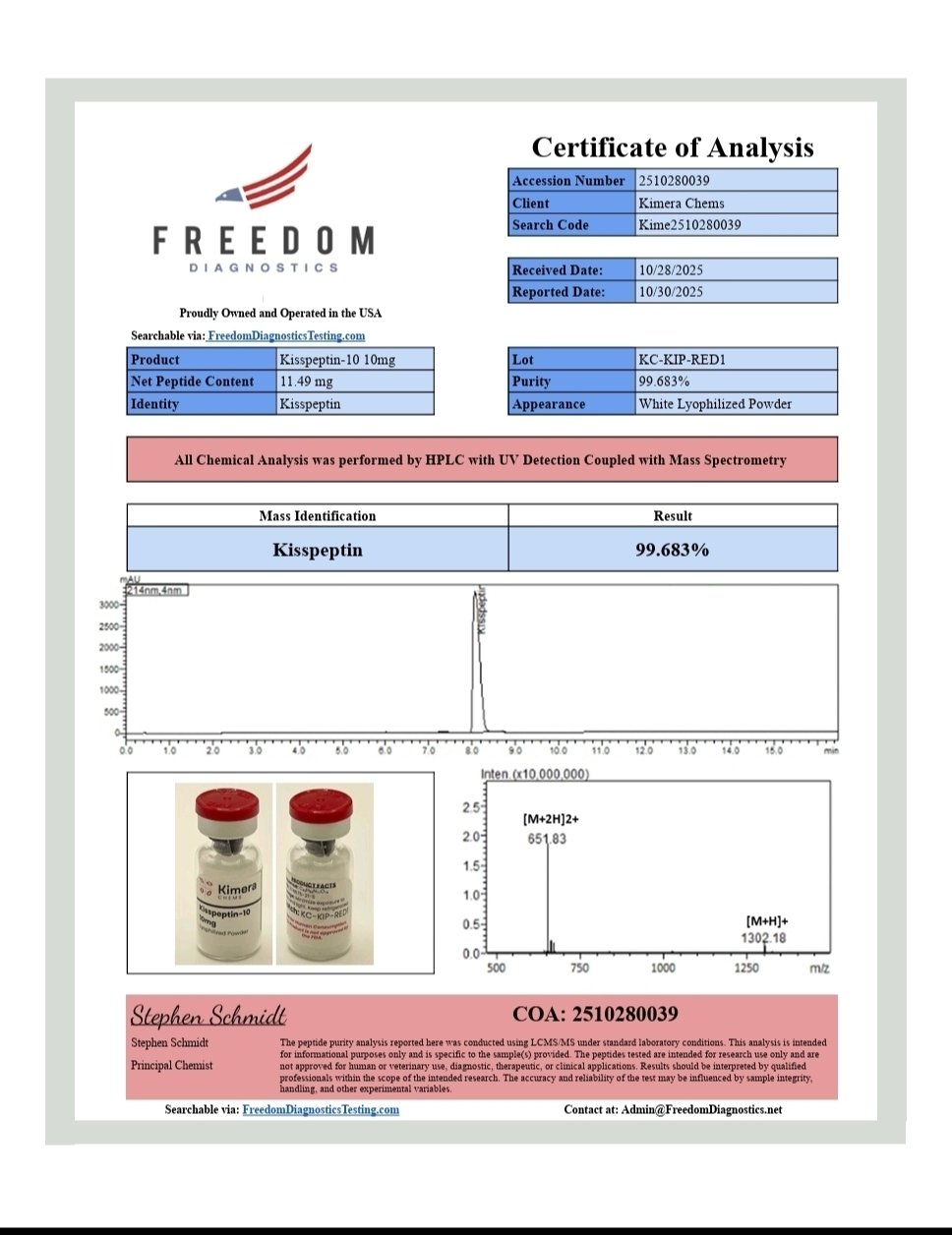
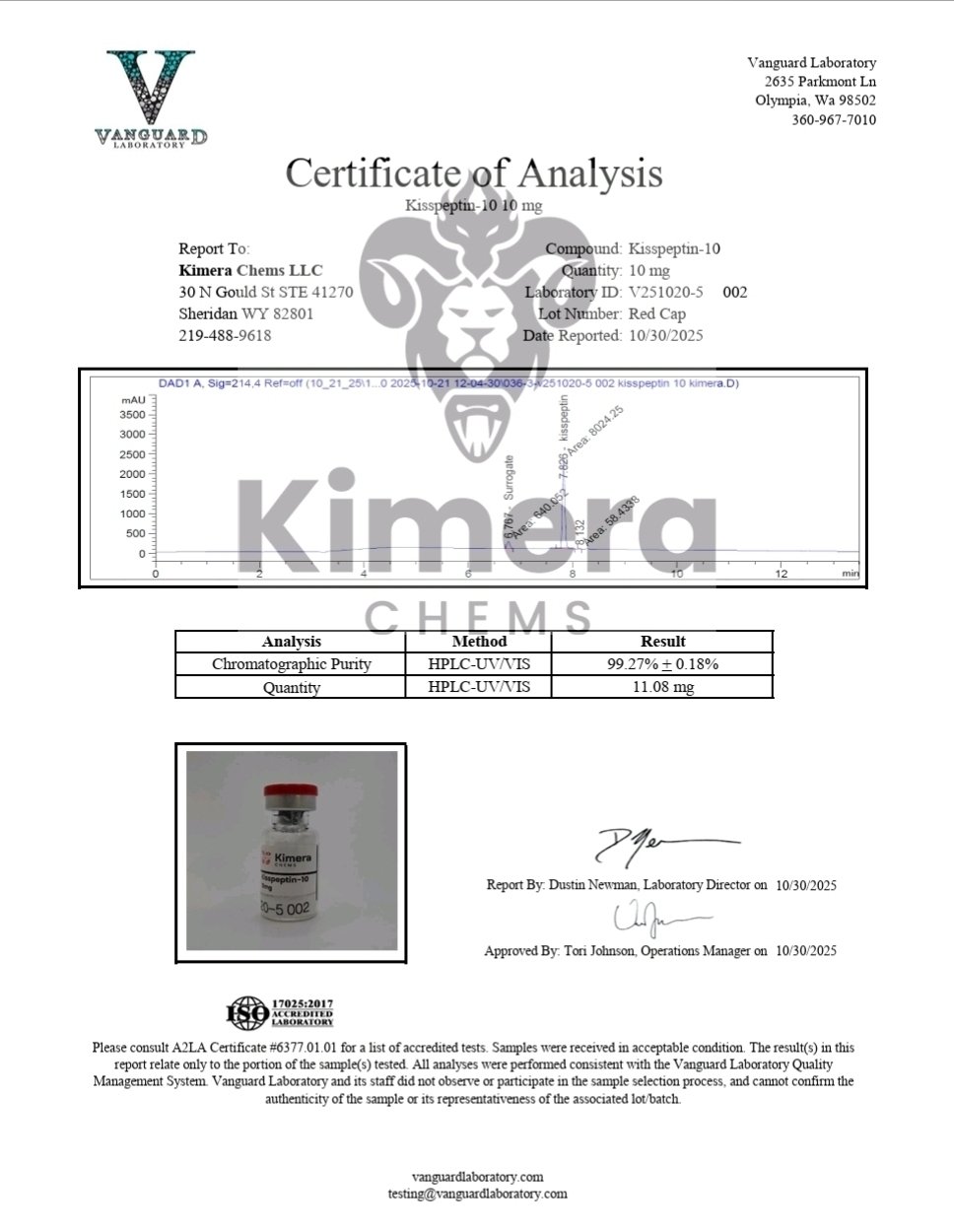
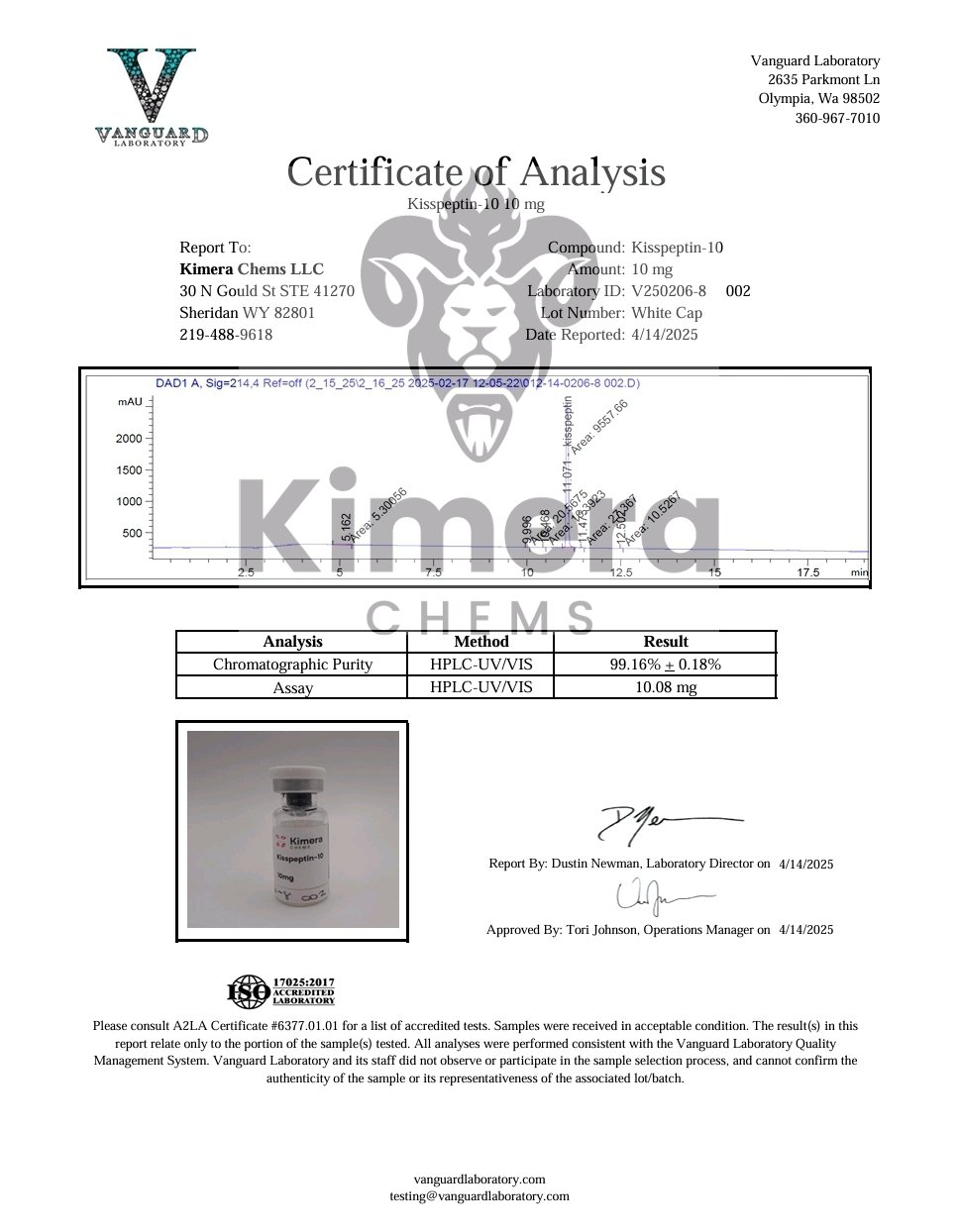
The product’s molecular formula is C₆₃H₈₃N₁₇O₁₄. The molecular weight of the compound is 1302.4 g/mol. It appears as a white to off-white powder. The form is lyophilized. Kimera Chems checks every batch for quality through third-party testing. They use high-performance liquid chromatography (HPLC). This analysis confirms the chemical identity. It also verifies the purity, which is ≥98%. Having reliable chemical data is necessary for accurate laboratory results.
Research Applications
Investigators use this peptide to map the pathways of hormonal regulation. The research focuses on the interaction between the decapeptide and the GPR54 receptor in cell cultures. All the research is performed in controlled in vitro settings.
- Receptor Binding Analysis: Researchers measure how tightly the peptide attaches to the G-protein-coupled receptor.
- Signal Pathway Mapping: Scientists track the chemical signals that occur inside the cell after binding.
- Structural Degradation Studies: Labs examine how long the peptide lasts in different chemical environments.
- Neuroendocrine Modeling: Investigators use the compound to simulate signaling in the hypothalamus.
- Molecular Docking Tests: Scientists use the peptide to confirm computer models of protein shapes.
Storage & Handling Protocol
Keeping peptides stable requires careful attention to the lab environment. If the storage is poor, the sample can be degraded. Scientists should use these methods to keep the sample pure.
- Lyophilized peptides can be kept at room temperature, away from direct light.
- If reconstituted, the sample should be kept in the fridge.
- For long-term storage, the material must be stored in the freezer.
- Always keep the lid tight to stop moisture from getting inside.
- Place the container in a dry spot with a desiccant.
Compliance & Usage Disclaimer
This compound is for Research Use Only (RUO). It is strictly not for human or animal use. It is not a drug, food, or health supplement. Kimera Chems lists Kisspeptin-10 for sale only for use by professional labs and verified scientific investigators.
Availability & Research Sourcing
Finding high-quality peptides is vital for any laboratory project. Kimera Chems offers a consistent supply of premium reagents for molecular research. We focus on providing clear data for every batch we ship. When you decide to buy Kisspeptin-10, you receive a product that has been fully verified for purity. We understand that your research depends on using the best materials. Our goal is to provide the tools you need for precise and repeatable scientific work.
| CAS Number | 374675-21-5 |
| Other Names | Kisspeptin 10, Metastin (45-54), KP-10, Metastin 45-54, UNII-FS1N52VS3S, FS1N52VS3S, CHEMBL376756 |
| IUPAC Name | 2S)-N-[(2S)-1-[[(2S)-4-amino-1-[[(2S)-1-[[(2S)-1-[[2-[[(2S)-1-[[(2S)-1-[[(2S)-1-amino-1-oxo-3-phenylpropan-2-yl]amino]-5-(diaminomethylideneamino)-1-oxopentan-2-yl]amino]-4-methyl-1-oxopentan-2-yl]amino]-2-oxoethyl]amino]-1-oxo-3-phenylpropan-2-yl]amino]-3-hydroxy-1-oxopropan-2-yl]amino]-1,4-dioxobutan-2-yl]amino]-3-(1H-indol-3-yl)-1-oxopropan-2-yl]-2-[[(2S)-2-amino-3-(4-hydroxyphenyl)propanoyl]amino]butanediamide |
| Molecular Formula | C₆₃H₈₃N₁₇O₁₄ |
| Molecular Weight | 1302.4 |