
What Is Arimistane?
Arimistane, chemically known as Androsta-3,5-diene-7,17-dione, is a synthetic, non-steroidal aromatase inhibitor originally developed for experimental endocrine research. It is structurally derived from androstanes and functions as a suicide (irreversible) aromatase inhibitor in laboratory models.
Arimistane is not approved for human or veterinary use and is supplied strictly as a research-use-only (RUO) compound for qualified laboratories and investigators.
Chemical & Physical Properties
| Property | Specification |
|---|---|
| Chemical Name | Androsta-3,5-diene-7,17-dione |
| Common Name | Arimistane |
| Molecular Formula | C₁₉H₂₄O₂ |
| Molecular Weight | ~284.39 g/mol |
| Chemical Class | Androstane derivative |
| Functional Category | Aromatase inhibitor (AI) |
| Appearance | White to off-white crystalline powder |
| Solubility | Soluble in DMSO, ethanol; limited solubility in water |
| Stability | Stable under dry, cool, light-protected conditions |
Mechanism of Action (Research Context)
In in-vitro and preclinical models, Arimistane has been shown to:
-
Bind irreversibly to the aromatase (CYP19A1) enzyme
-
Inhibit conversion of androgens to estrogens
-
Reduce estrogen synthesis in controlled laboratory systems
-
Serve as a comparator compound in estrogen-pathway research
Because Arimistane acts as a suicide inhibitor, enzyme activity does not recover until new aromatase enzymes are synthesized—making it useful in mechanistic and duration-of-action studies.
Research Applications
Arimistane is commonly utilized in:
-
Aromatase inhibition assays
-
Estrogen pathway suppression studies
-
Endocrine signaling research
-
Androgen–estrogen balance models
-
Comparative AI research (steroidal vs non-steroidal)
-
Structure–activity relationship (SAR) analysis
All applications must remain non-clinical and non-consumptive.
Analytical Testing & Quality Control
High-quality Arimistane research material is typically verified using:
-
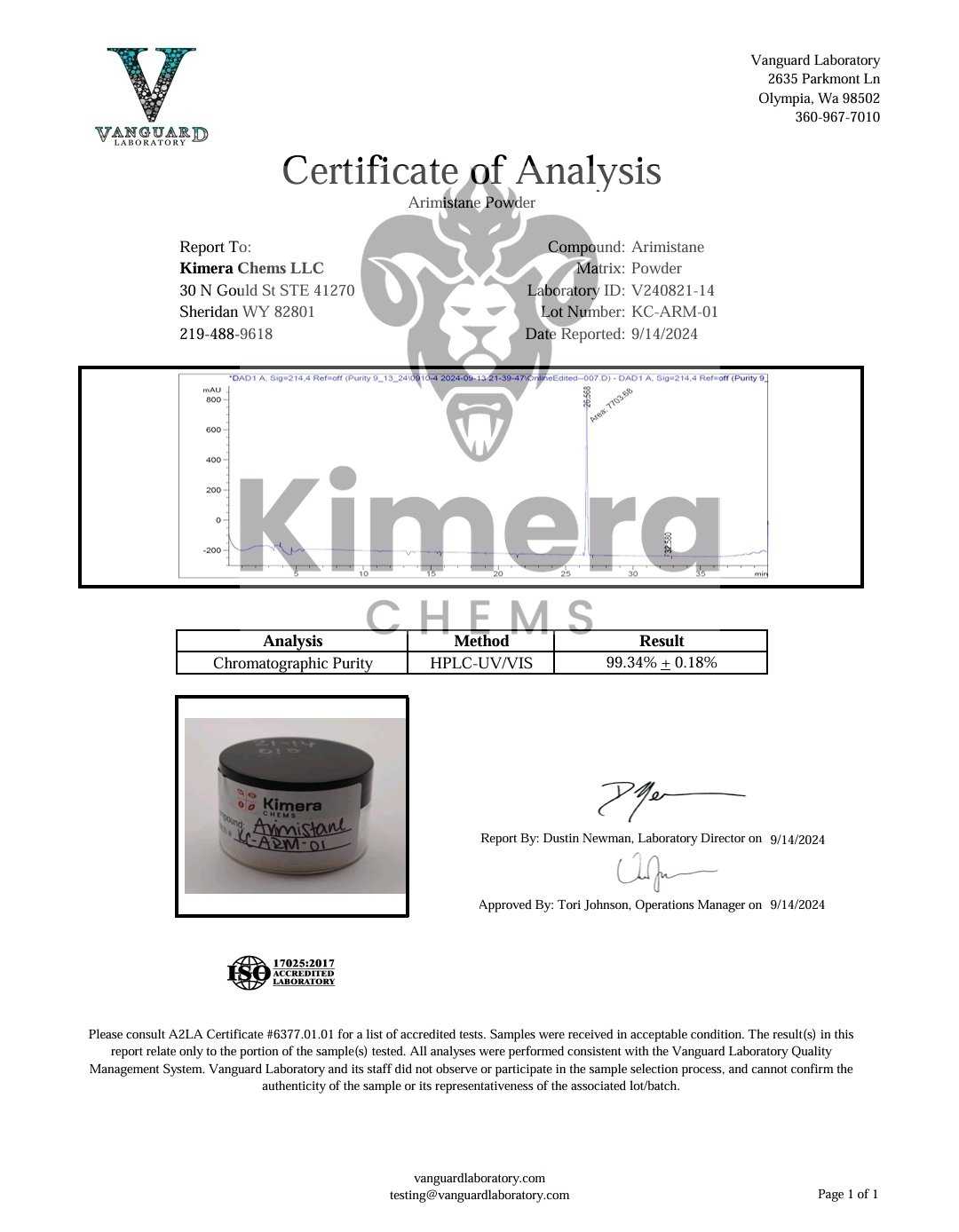
HPLC for purity and retention profile
-
Mass spectrometry (MS) for molecular confirmation
-
NMR spectroscopy for structural validation
-
Residual solvent analysis (when applicable)
Each batch should be traceable by lot number and accompanied by a Certificate of Analysis (COA).
Storage & Handling Guidelines
-
Store in a cool, dry environment
-
Protect from light and moisture
-
Recommended temperature: 2–8 °C for long-term storage
-
Handle with appropriate laboratory PPE
-
Avoid repeated exposure to ambient air
Regulatory & Compliance Status
-
Not a dietary supplement
-
Not a drug
-
Not approved for human or animal use
-
Sold strictly for research and laboratory purposes
-
Buyer assumes all responsibility for regulatory compliance
Frequently Asked Questions (FAQ)
Is Arimistane a steroid?
Arimistane is a synthetic androstane derivative, but it is not classified as an anabolic steroid in research literature. It is studied primarily for aromatase inhibition.
Is Arimistane orally bioavailable?
Bioavailability data exists only in experimental models. No approved human pharmacokinetic data exists.
Can Arimistane be used in vivo?
Only in approved, compliant laboratory research settings. It is not approved for clinical or consumer use.
Disclaimer
This product is sold for research use only (RUO).
Not for human consumption, medical use, or veterinary use.
All information provided is for educational and scientific reference purposes only.
| CAS Number | 1420-49-1 |
| IUPAC Name | (8R,9S,10R,13S,14S)-10,13-dimethyl-2,8,9,11,12,14,15,16-octahydro-1H-cyclopenta[a]phenanthrene-7,17-dione |
| Molecular Formula | C19H24O2 |
| Molecular Weight | 284.17 g/mol |
| Dry-Fill Capsule Concentration | 50mg |